

The Most Common Reasons Businesses Stop Following Up After the Second Attempt
Many local service businesses have a predictable follow-up pattern.
A lead submits a form, requests an estimate, calls the office, or books a consultation. Someone reaches out once. A second attempt follows a day or two later. If there is no response, the conversation effectively ends.
The prospect is assumed to be uninterested, and attention shifts to newer opportunities.
The problem is that many buying decisions take longer than two contact attempts.
People get busy. Projects get delayed. Estimates get reviewed weeks later. Financing, scheduling, and family decisions often slow down the process. Meanwhile, the business has already moved on.
As a result, many leads are lost before a real decision is ever made.
Understanding why businesses stop following up after the second attempt can help identify weaknesses in the sales process and reveal opportunities that may already exist inside the CRM.
Key Takeaways: Why Businesses Stop Following Up After the Second Attempt
- New inquiries naturally pull attention away from older opportunities.
- Many sales teams interpret silence as rejection before a decision has been made.
- Follow-up often depends on individual effort instead of a repeatable process.
- Older leads become less visible as CRM records accumulate.
- Manual follow-up becomes harder to maintain as lead volume grows.
- Many businesses generate enough leads but fail to consistently work them through the entire sales cycle.
1. New Leads Always Feel More Urgent
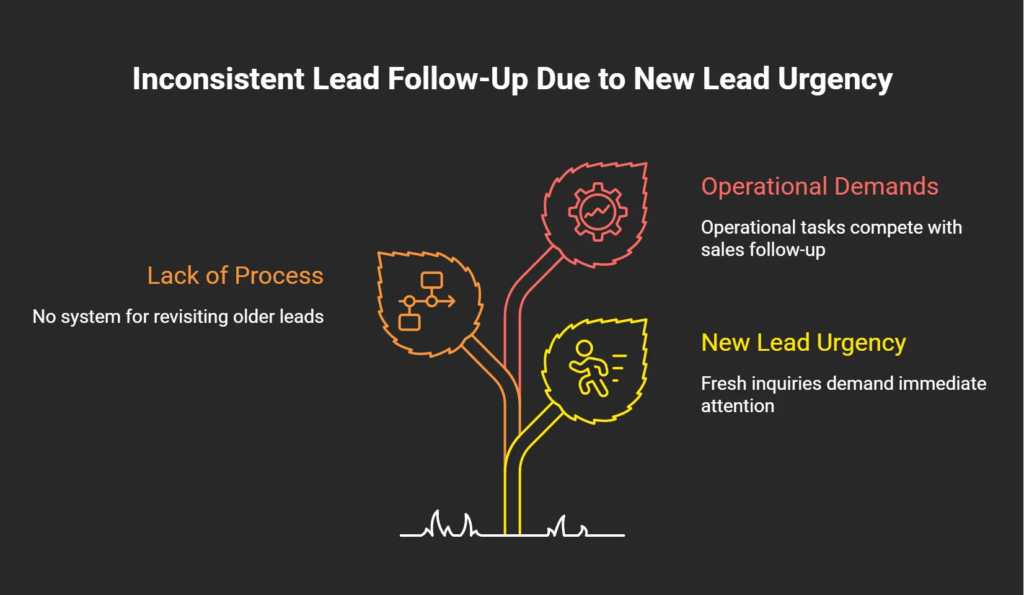
One of the biggest reasons businesses stop following up after the second attempt is simple: new leads demand attention.
A fresh inquiry feels active. Someone just requested a quote, called the office, or asked for pricing. The opportunity appears immediate and time-sensitive.
Older leads rarely create the same urgency.
As more inquiries arrive, yesterday’s leads receive less attention. Last week’s estimates move further down the list. Conversations that were once active slowly disappear from daily workflows.
Most businesses have a process for responding to new leads.
Far fewer have a process for revisiting older ones.
This creates a cycle where staff spend most of their time reacting to incoming opportunities while previously interested prospects sit untouched inside the CRM.
We see this frequently in industries such as roofing, HVAC, dental, legal, and remodeling services where operational demands compete directly with sales follow-up.
The result is predictable: businesses continue chasing new opportunities while existing ones receive fewer and fewer touches over time.
2. Silence Gets Mistaken for Rejection
A lead who doesn’t respond is not necessarily saying no.
Yet many businesses behave as if silence and rejection are the same thing.
After one phone call and a second follow-up attempt, the prospect stops replying. Without additional information, the sales team assumes the opportunity is gone and moves on.
In reality, many prospects are simply delaying the decision.
A homeowner may still be reviewing estimates. A patient may be waiting for the next paycheck. A business owner may be comparing providers before committing.
The challenge is that businesses rarely know why someone stopped responding.
What they do know is that they didn’t get an immediate reply.
That uncertainty often leads to premature abandonment of the lead.
This becomes especially common with higher-ticket services where buying cycles are longer and decisions involve more consideration.
Many businesses stop following up long before the prospect has reached a final decision.
The lead appears cold because communication stopped, not because interest disappeared.
3. There Is No System Requiring Continued Follow-Up
Many businesses rely on effort instead of process.
Someone makes a call.
Someone sends a text.
Someone plans to follow up later.
What happens next is often unclear.
Without a structured process, follow-up becomes dependent on memory, availability, and personal discipline.
That approach works reasonably well when lead volume is low.
As more leads enter the system, it becomes increasingly difficult to remember who needs another call, who received a quote, and who has not responded yet.
This is where many CRM setups fall short.
The contact record exists, but there are no follow-up schedules, task assignments, reminders, or workflows ensuring the conversation continues.
As daily responsibilities increase, follow-up becomes one of the easiest activities to postpone.
Technicians need scheduling. Estimates need to be prepared. Customers need support. Administrative work piles up.
Without a process that clearly defines the next step, most leads stop receiving attention after the first few contact attempts.
At TTRAN, we regularly find valuable opportunities sitting untouched in CRMs not because anyone intentionally ignored them, but because there was no system keeping them active.
4. Older Leads Become Invisible
Many businesses underestimate the value of older opportunities simply because they stop seeing them.
New leads appear at the top of dashboards, inboxes, and notifications.
Older leads slowly sink into the background.
Over time, estimate requests, consultation inquiries, and previous conversations become buried beneath newer activity.
This creates a perception problem.
Older leads begin to feel less valuable because they are no longer visible, not because they were disqualified.
In reality, many of these contacts never reached a clear outcome.
A homeowner who requested a quote months ago may have postponed the project. A patient who delayed treatment may now be ready to move forward. A prospect who stopped responding may simply need another conversation at a different time.
When businesses stop reviewing older records, these opportunities remain dormant indefinitely.
Meanwhile, marketing budgets continue generating new inquiries while existing opportunities remain untouched.
This is one of the reasons lead reactivation campaigns often uncover opportunities businesses forgot they had.
5. Manual Follow-Up Doesn’t Scale Well
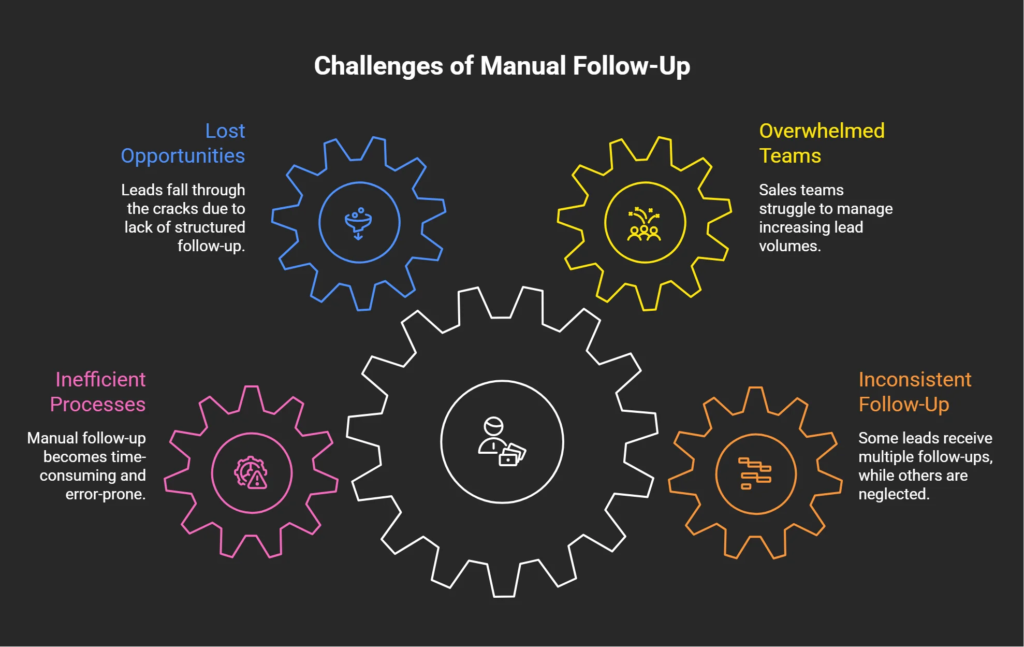
As lead volume increases, follow-up becomes harder to manage manually.
What works with five leads per week often breaks down with fifty.
Owners and sales teams can usually remember every conversation when lead flow is small. As the pipeline grows, that becomes unrealistic.
Callback lists expand.
Unanswered estimates accumulate.
CRM records pile up.
Every lead requires additional touches, reminders, reviews, and conversations.
Eventually, follow-up begins competing with every other responsibility inside the business.
When that happens, consistency suffers.
Some leads receive multiple follow-ups. Others receive one or two attempts and then disappear from the workflow entirely.
This is not usually caused by lack of effort.
It happens because the volume of conversations exceeds what people can reliably track on their own.
The larger the lead flow becomes, the more important structured follow-up becomes.
Without it, opportunities gradually fall through the cracks regardless of how effective lead generation is.
Businesses rarely stop following up after the second attempt because they intentionally choose to ignore potential customers.
More often, follow-up ends because new leads demand attention, silence gets mistaken for rejection, older opportunities become less visible, and manual processes become difficult to maintain consistently.
The result is a sales process that captures leads but does not always work them through to a decision.
Before increasing advertising spend or searching for additional lead sources, it is worth reviewing how many conversations ended after only one or two follow-up attempts.
At TTRAN, we often find that the biggest opportunities are not hidden in future leads. They are sitting inside existing CRMs, estimate pipelines, and call logs waiting for someone to continue the conversation.