

What Happens When Lead Volume Outgrows the Sales Process
A strange thing happens in many growing local service businesses.
The phone rings more often. More quote requests come in. Marketing appears to be working. Yet bookings don’t increase at the same rate.
The business feels busier than ever, but conversion starts slipping.
Callbacks take longer. Estimates get sent but never revisited. Leads sit inside the CRM waiting for follow-up while new inquiries continue arriving every day.
Most owners assume they need more leads when growth starts slowing down. Often, the real issue is that the sales process can no longer keep up with the volume already coming in.
When lead volume outgrows the sales process, the bottleneck shifts from demand to execution.
This article breaks down what that looks like in day-to-day operations, why it happens in local service businesses, and how growth can expose weaknesses in follow-up, conversion, and pipeline management long before it shows up in revenue reports.
Key Takeaways: When Lead Volume Outgrows the Sales Process
- More leads do not automatically create more revenue when follow-up capacity remains unchanged.
- Delayed responses and inconsistent follow-up are often the earliest warning signs.
- Quote backlogs and inactive CRM records frequently indicate a capacity problem.
- Revenue loss typically occurs after lead generation, not before it.
- Scaling lead volume without improving sales processes increases operational pressure.
- Businesses with strong demand but inconsistent conversion often benefit more from process improvements than additional marketing.
What It Means When Lead Volume Outgrows the Sales Process
A business reaches this point when it generates more inquiries than it can consistently respond to, track, and follow up with.
The change is usually gradual.
New leads still receive attention. Jobs are still being booked. Revenue may even continue growing for a while.
The warning signs appear in the activities that stop happening consistently.
Callbacks take longer.
Follow-up schedules become less reliable.
Older estimates receive less attention.
Prospects who were interested a few weeks ago remain in the CRM without any recent activity.
The business is still generating opportunities, but it is no longer working all of them equally well.
This distinction matters because many owners continue focusing on lead generation while conversion capacity quietly becomes the real limitation.
At that stage, growth is constrained by execution rather than demand.
The question shifts from “How do we get more leads?” to “How do we prevent existing leads from slipping through the cracks?”
Early Warning Signs the Sales Process Is Falling Behind
Most sales processes do not fail all at once.
The breakdown starts with small operational inconsistencies.
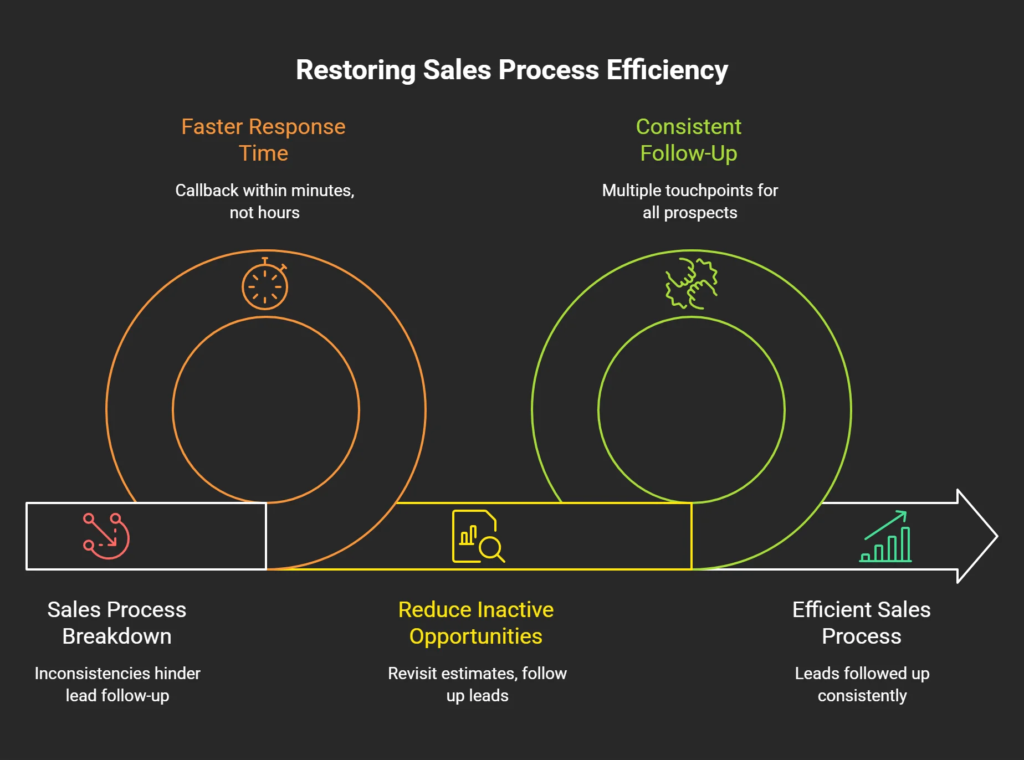
One of the earliest signs is slower response time.
A lead that previously received a callback within minutes now waits several hours. Messages sit unread longer than they used to. Staff respond when they have time rather than through a consistent process.
Another common warning sign is the accumulation of inactive opportunities.
Businesses begin seeing:
- estimates sent but never revisited
- leads marked active with no recent activity
- prospects who requested information but never received additional follow-up
- CRM records that remain open indefinitely
The pipeline appears full, but much of it is not actively moving.
Follow-up inconsistency is another major indicator.
Some prospects receive multiple touchpoints.
Others receive one or two attempts and then disappear from the workflow entirely.
The issue is rarely visible in reporting at first. Revenue may still be growing.
The warning signs show up in operational behavior before they appear in financial results.
At TTRAN, we often see these symptoms long before a business realizes it has a conversion-capacity problem.
Why Increased Lead Volume Creates These Problems
Most local service businesses scale lead generation faster than they scale lead management.
Marketing improves.
Advertising budgets increase.
Referral volume grows.
The number of incoming opportunities expands.
The sales process often stays the same.
The first breakdown usually occurs in response speed.
When lead volume is low, owners and staff naturally respond quickly because every inquiry receives personal attention.
As volume increases, incoming leads compete for time and attention.
Even small delays begin affecting conversion rates.
The second breakdown occurs in follow-up.
New inquiries always feel more urgent than old ones.
As a result:
- fresh leads receive attention
- older opportunities get postponed
- follow-up becomes inconsistent
- estimates remain unresolved
Over time, pipeline visibility starts deteriorating as well.
CRM records accumulate faster than they are reviewed. Sales stages become outdated. Nobody has a clear picture of which opportunities still need attention.
The result is a system that continues collecting leads but struggles to move them consistently toward a decision.
Many businesses interpret this as a lead-quality issue when the underlying problem is process capacity.
How Businesses Restore Capacity Without Reducing Lead Flow
The solution is rarely generating fewer leads.
The solution is improving the system responsible for handling them.
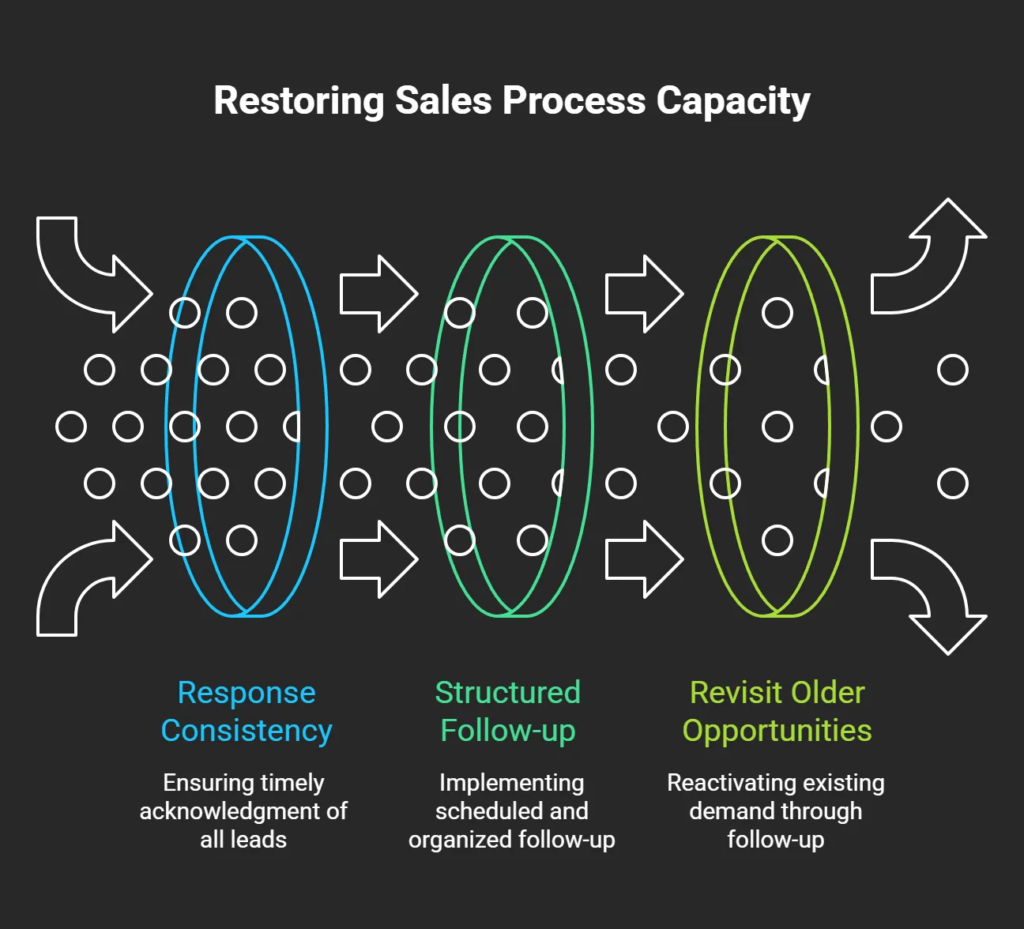
The first priority is response consistency.
Every lead should receive a timely acknowledgment regardless of how busy the team becomes.
The second priority is structured follow-up.
Many businesses rely on memory, sticky notes, inboxes, or individual effort to manage ongoing conversations. That approach becomes unreliable as lead volume increases.
A stronger process ensures that:
- every lead has a next step
- follow-up happens on a schedule
- opportunities remain visible
- conversations do not disappear after the initial outreach
The third priority is revisiting older opportunities.
Businesses often focus exclusively on new inquiries while estimates, quote requests, and previous conversations sit untouched in the CRM.
These records frequently represent demand that already exists.
When reactivation becomes part of the process, the business gains another source of revenue without increasing marketing spend.
At TTRAN, we typically view this as restoring control over existing demand rather than adding complexity. The objective is to make sure opportunities continue moving through the pipeline instead of accumulating inside it.
When lead volume outgrows the sales process, the problem is rarely visible in the marketing channel.
Leads are still arriving.
Demand still exists.
The breakdown happens after the inquiry enters the business.
Response times slow down. Follow-up becomes inconsistent. Estimates stop moving. Older opportunities disappear into the CRM without reaching a decision.
Many businesses respond by generating even more leads, which often increases pressure on an already strained system.
At TTRAN, we frequently find that growth exposes weaknesses that were already present. The challenge is not acquiring additional opportunities. The challenge is making sure existing opportunities receive the attention needed to become revenue. Once response, follow-up, and pipeline management become consistent, lead volume stops creating operational strain and starts producing more predictable results.