

Bottom-of-Funnel Keywords for SOC 2 Automation Software Companies
If you sell SOC 2 automation software, “keyword research” isn’t a traffic exercise. It’s a way to show up when a buyer is already evaluating vendors and trying to reduce decision risk.
This category is high-trust and high-stakes. Buyers rarely browse. They pressure-test. They compare options, look for proof, and sanity-check fit before they ever book a demo.
The searches you want are coming from people asking questions like:
- Which tool is the right fit for our team?
- Is this vendor credible, or just good at marketing?
- Will this work with our stack and compliance workflow?
This article lays out a bottom-of-funnel keyword map you can build pages around. The goal is simple: attract higher-intent searches, support evaluation, and turn SEO into a pipeline asset instead of a content treadmill.
Key Takeaways
- BOFU keywords in SOC 2 automation signal active evaluation, not general research
- The highest-converting buckets are comparisons, alternatives, “best tools,” pricing, reviews, and implementation intent
- “Hidden BOFU” keywords often come from integration fit, buyer role, and readiness vs automation decisions
- The right page type matters as much as the keyword (intent → page format → conversion)
- Volume tools undercount this niche, so prioritize intent, page fit, and sales alignment
- BOFU pages fail when they avoid tradeoffs, hide pricing, or skip workflow/integration objections
What “bottom-of-funnel” means in SOC 2 automation
In SOC 2 automation, bottom-of-funnel keywords are the searches that signal active evaluation. The person searching is already aware of the category. They’re trying to make a decision, defend it internally, and avoid picking the wrong tool.
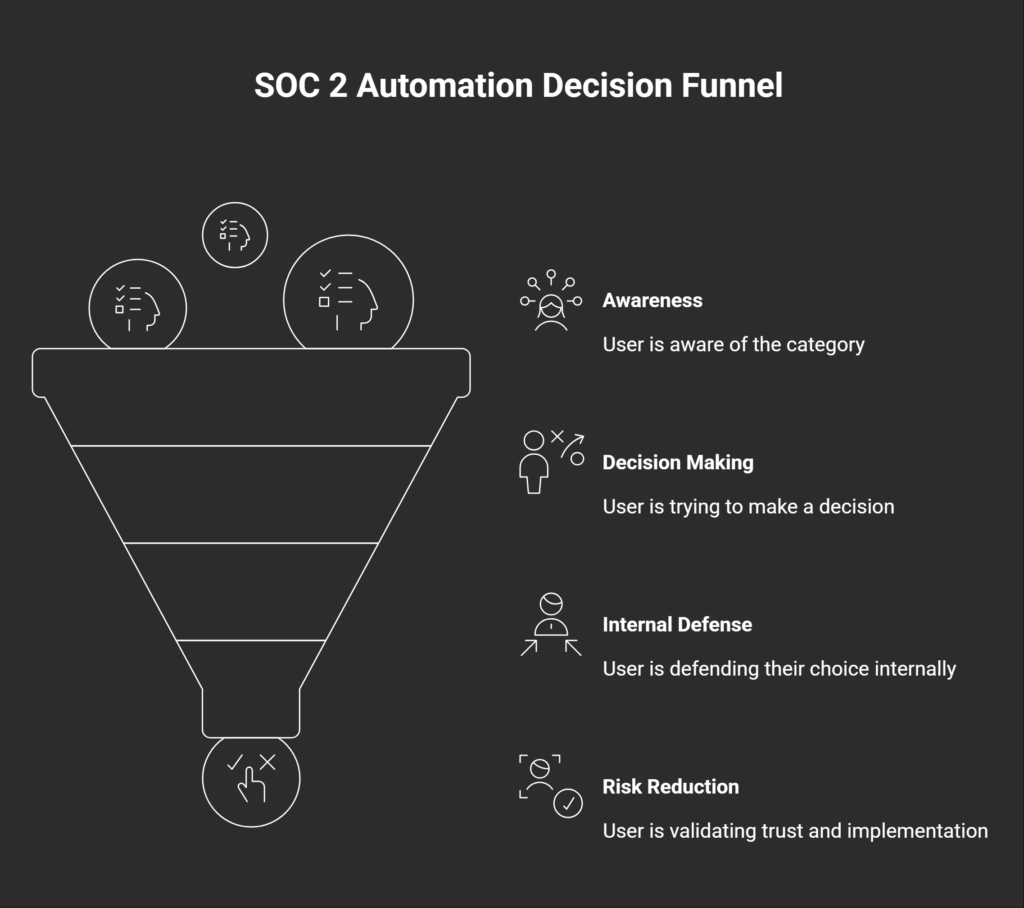
You can usually spot BOFU intent in this niche when the search has one or more of these signals:
| BOFU signal | What it usually means |
| Includes a vendor name or tool category | They’re building a shortlist |
| Implies decision pressure (pricing, alternatives, reviews) | They’re close to a yes/no decision |
| Implies risk reduction (security, evidence, audit readiness) | They’re validating trust and implementation fit |
The BOFU keyword types that actually drive demos
In SOC 2 automation, most bottom-of-funnel keywords fall into a few repeatable intent buckets. Each bucket maps to a specific decision the buyer is trying to make. If you match the page to the decision, these searches tend to convert because the reader is already in evaluation mode.
Here’s the skimmable breakdown:
| Intent bucket | What the buyer is deciding | Why it converts | What the page needs to do |
| Comparison (“X vs Y”) | “Which of these two is the better fit?” | They’re shortlisting | Stay neutral and use real decision criteria |
| Alternatives (“X alternatives”) | “What else should we consider?” | They’re looking for a better match | Frame options by use case and constraints |
| Best tools / shortlist | “What are the top options in this category?” | They want a curated list | Show your evaluation logic, not hype |
| Pricing / cost | “Can we afford this and justify it?” | They’re checking budget before buy-in | Explain cost drivers and expectations |
| Reviews / trust | “Is this legit?” | They’re validating credibility | Use proof, tradeoffs, and context |
| Implementation / workflow | “Will this work in our environment?” | They’re imagining rollout | Show ownership, timeline, and lift |
Comparison keywords (“X vs Y”)
Comparison searches convert because the buyer is already narrowing down options. They’re usually past category education. They want clarity on fit, tradeoffs, and risk.
A good “X vs Y” page earns trust by staying neutral. It should make the decision easier, even if the reader chooses the other vendor. That tone matters in SOC 2 automation because multiple stakeholders will read the page, and nobody wants to feel like they were sold to.
Decision criteria that typically matter here include: implementation effort, evidence coverage, integrations, auditor workflow, and how much ongoing manual work remains after setup.
Examples
- vanta vs drata
- vanta vs secureframe
- drata vs secureframe
- vanta vs scrut
- drata vs scrut
Alternatives keywords (“X alternatives”)
Alternatives searches show a slightly different mindset. The buyer is still evaluating, but they’re actively looking for a different fit. That could be pricing pressure, complexity, missing features, or internal resistance to a specific approach.
These pages work when they acknowledge why someone might be switching. The best positioning is simple and direct: if you’re leaving because of this constraint, here are the options that tend to fit better.
It also helps to separate “true alternatives” from adjacent categories. Some buyers are deciding between software, a consultant-led path, or doing it manually with spreadsheets. That decision should be handled without judgment.
Examples
- vanta alternatives
- drata alternatives
- secureframe alternatives
- scrut alternatives
- best vanta alternatives for startups
“Best tools” / shortlist keywords
“Best tools” keywords convert because the buyer wants a curated shortlist. They’re not asking for SEO education. They want someone to do the sorting and give them a clear starting point.
These pages lose trust when they read like affiliate content. The way to avoid that is to be explicit about your criteria. What makes a tool “best” depends on the buyer’s situation. A startup going through SOC 2 for the first time has different needs than a larger SaaS company tightening controls across multiple teams.
The goal is to help the reader self-qualify into the right bucket, then choose from a small set of options.
Examples
- best SOC 2 automation software
- best SOC 2 compliance software
- best compliance automation tools
- SOC 2 automation tools for startups
- SOC 2 automation platform
Pricing + cost keywords
Pricing searches tend to show up right before internal approval. Someone is trying to sanity-check budget, forecast total cost, and avoid surprises after a sales call.
In SOC 2 automation, pricing is rarely straightforward. It can vary by employee count, integrations, number of frameworks, and support level. That’s why pricing pages should focus on ranges and cost drivers, not exact numbers unless you can state them accurately.
A strong pricing page also reduces friction for sales. It filters out bad-fit leads while helping serious buyers come prepared with realistic expectations.
Examples
- vanta pricing
- drata pricing
- SOC 2 automation software pricing
- SOC 2 compliance software cost
- how much does SOC 2 automation cost
Review / trust keywords
Review searches are trust checks. The buyer is trying to confirm that a vendor is credible and that the product holds up in real-world use.
In high-trust categories, these pages win by being specific. Generic praise doesn’t help. Buyers want constraints, outcomes, and tradeoffs. They want to know what the tool is great at, where it’s weaker, and what type of team it fits.
If your review content reads like a landing page, it will be treated like one. If it reads like a careful evaluation, it becomes part of the buyer’s internal justification.
Examples
- vanta review
- drata review
- secureframe review
- SOC 2 automation software reviews
- is vanta worth it
Implementation + workflow keywords (BOFU disguised as “how-to”)
Implementation and workflow searches look informational on the surface, but they’re often BOFU. The buyer is picturing rollout. They’re thinking about time-to-value, internal ownership, and how much work will land on engineering, security, and ops.
These keywords are especially strong for teams that are worried about lift. They’re not trying to become compliance experts.
The best pages here make the process feel legible. They clarify what gets automated, what still needs human input, and what “done” looks like.
Examples
- SOC 2 automation implementation
- SOC 2 readiness checklist software
- how to automate SOC 2 evidence collection
- SOC 2 audit preparation software
- SOC 2 compliance workflow tool
The “hidden BOFU” keywords most SOC 2 companies ignore
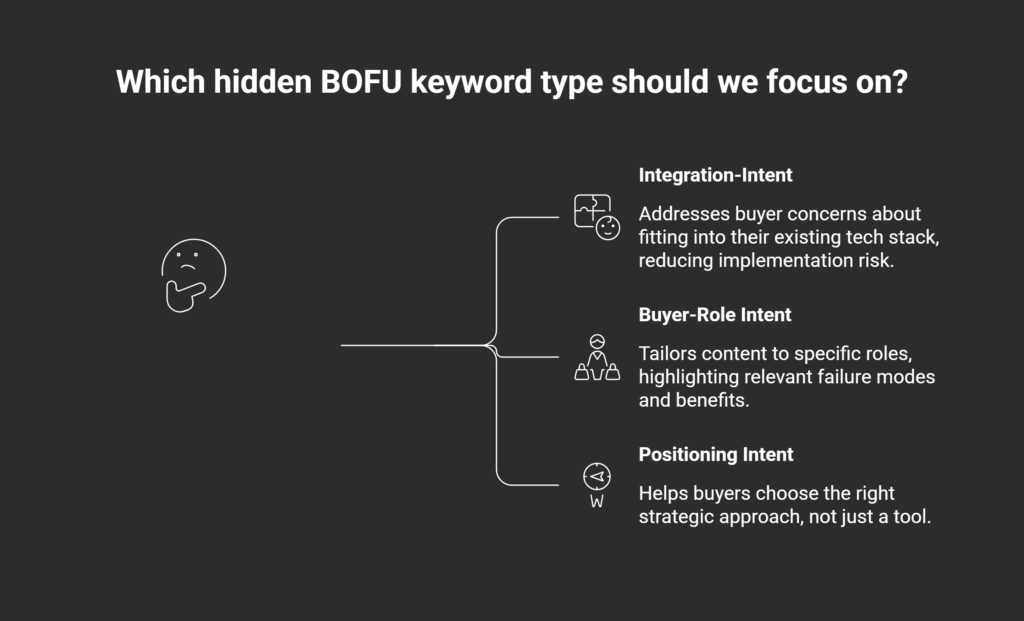
The intent buckets above capture the obvious evaluation searches. Most SOC 2 automation companies stop there. The problem is that some of the highest-quality buyers don’t search in obvious category terms. They search in ways that reflect internal constraints.
These keywords aren’t flashy, but they tend to bring in serious evaluators.
| Hidden BOFU keyword type | What the buyer is trying to confirm | Why it matters |
| Integration-intent | “Will this fit our stack without pain?” | Implementation risk is a deal-breaker |
| Buyer-role intent | “Is this built for teams like ours?” | Different roles care about different failure modes |
| Positioning intent | “Which approach is right for us?” | Buyers are choosing a path, not just a tool |
Integration-intent keywords
These searches usually come from engineering, security, or ops. The buyer is looking for signs that the product works in their environment without creating a long internal project.
Examples:
- “SOC 2 automation software Jira integration”
- “SOC 2 automation software AWS”
- “SOC 2 automation for GitHub”
- “SOC 2 automation for Okta”
Buyer-role keywords
The same product can look “right” or “wrong” depending on who’s evaluating it. Founders want speed and simplicity. Security wants defensibility. Ops wants ownership to be clear.
Examples:
- “SOC 2 automation for startups”
- “SOC 2 automation for SaaS”
- “SOC 2 automation for devops teams”
“Readiness vs automation” positioning keywords
These searches show up when a team is deciding between approaches. They’re trying to avoid buying software when they actually need a readiness process, or hiring services when software would be enough.
Examples:
- “SOC 2 readiness platform vs automation”
- “SOC 2 consultant vs SOC 2 software”
What pages to build for these keywords
Once you know the intent bucket, the page format becomes straightforward. In SOC 2 automation, ranking is usually not the hard part. Conversion is. The pages that perform best are the ones that match the decision the buyer is trying to make and give them a clean way to evaluate.
Use this mapping as your default:
| Keyword type | Best page type | What the page should help the buyer decide |
| Comparisons | “X vs Y” page | Which option fits their team and constraints |
| Alternatives | “Alternatives to X” page | What else is worth considering, and why |
| Best tools | Category shortlist page | Which tools belong on the shortlist |
| Pricing | Pricing explainer page | Whether the cost is realistic and justifiable |
| Reviews | “Our take” review page | Whether the vendor is credible in practice |
| Implementation / workflow | “How it works” page | How rollout works, who owns it, and how long it takes |
| Integrations | Integration landing page | Whether it fits their stack with minimal friction |
How to choose BOFU keywords when search volume looks like “0”
In SOC 2 automation, keyword tools routinely undercount demand. Searches are fragmented across vendor names, niche phrasing, and long-tail queries that only show up once someone is already evaluating. The volume looks small because the market is smaller, and because the highest-intent searches are the least repeatable.
Instead of optimizing for tool metrics, prioritize three things:
- Clear intent: the search signals evaluation, not curiosity
- Clear page fit: you can match it to a specific page type (comparison, pricing, integration, etc.)
- Clear sales conversation alignment: the topic comes up in real demos and objections
A quick validation checklist helps keep the list tight:
- Would a qualified buyer search this while shortlisting tools?
- Can we publish a page that answers it more clearly than the current results?
- Does the page naturally lead into a demo conversation without forcing it?
If the answer is “yes” across all three, it’s a BOFU keyword worth building around, even if the tool says it has no volume.
Common mistakes that kill BOFU conversions
Most SOC 2 automation companies don’t lose BOFU traffic because they picked the wrong keywords. They lose it because the page doesn’t support evaluation. The reader clicks, scans, and leaves without feeling more confident in a decision.
Here are the most common conversion killers:
- Comparison pages that read like marketing copy
Buyers want decision criteria. If the page feels biased, it gets ignored or treated as sales collateral. - “Best tools” lists that feel affiliate-y
If there’s no clear evaluation framework, the shortlist looks arbitrary and trust drops fast. - Pricing content that hides behind vague language
You don’t need exact numbers, but you do need cost drivers, ranges, and what changes the price. - Avoiding tradeoffs
Serious buyers expect constraints. Honest tradeoffs reduce perceived risk and speed up internal buy-in. - Skipping integration and workflow pages
This is where real objections live. If the content doesn’t address stack fit and rollout effort, the buyer assumes it’s harder than it needs to be.
Bottom-of-funnel keywords are where SOC 2 automation buyers make decisions. These searches show up late in the evaluation process, when the reader is trying to choose a tool, justify the choice internally, and avoid surprises after purchase.
If you build the right pages for these intent buckets, SEO becomes a trust and pipeline engine. It supports the same questions your sales team gets on calls, but it does it earlier, and at scale.If you want the full strategy behind turning these keywords into a connected system, start here: the complete framework for SOC 2 automation software SEO