

Common SEO Mistakes SOC 2 Automation Software Companies Make
If you sell SOC 2 automation software, most SEO mistakes fail quietly.
Buyers in this market move carefully. They’re validating claims, looking for proof, and trying to avoid picking the wrong vendor. That changes what “good SEO” needs to do. It has to support evaluation, not just bring visits.
Small positioning and structure mistakes tend to compound into outcomes like:
- The wrong leads
- Stalled evaluation
- “We got traffic but no pipeline”
This article breaks down the most common SOC 2 automation software SEO mistakes, why they happen, and what to fix first. The goal is simple: attract fewer casual readers and more buyers who are already close to making a decision.
Key Takeaways
- Broad “compliance software” targeting attracts the wrong buyers and weakens conversion.
- Evaluation-focused content outperforms generic SOC 2 education for pipeline.
- Comparison and alternatives pages help buyers shortlist you during active evaluation.
- Feature pages should explain workflow impact, constraints, and internal ownership.
- Trust pages (security, implementation, proof) remove friction before the demo.
- High-intent searches often look messy and low-volume, but convert better.
- Internal linking turns one-off posts into a compounding evaluation system.
- Success should be measured by BOFU outcomes, not impressions and traffic.
Mistake #1: Writing for “compliance” too broadly
A common early mistake is treating “compliance software” like one clean category. It isn’t. The buyer intent behind that phrase ranges from SOC 2 automation to GRC platforms to vendor risk tools to consulting services.
This usually shows up in two ways:
- Targeting broad terms like “compliance software” without clarifying the product category
- Blending SOC 2 automation content with generic compliance consulting or advisory content
The problem is intent mismatch. A SOC 2 automation buyer is evaluating operational fit. They want to know what gets automated, what stays manual, how implementation works, and what internal teams will need to own. Broad compliance pages tend to attract readers who are earlier-stage, looking for definitions, or shopping for services.
The fix is straightforward:
- Define your ICP and category clearly on-page (SOC 2 automation software vs services)
- Build separate intent paths for each buyer type you want to serve (SOC 2 automation, GRC, vendor risk, etc.)
That keeps your traffic aligned with pipeline.
Mistake #2: Treating SEO like “top-of-funnel education” instead of evaluation support
Many SOC 2 automation companies default to educational content because it feels “safe.” It’s also the easiest type of content to justify internally. The result is usually a backlog of broad explainers that don’t move deals forward.
This often looks like:
- “What is SOC 2?” articles competing against massive publishers and audit firms
- Long-form guides that explain the concept well, but never help a buyer evaluate a vendor
The issue isn’t that education is bad. It’s that most SOC 2 automation buyers who are close to purchase already understand the basics. Their uncertainty is operational. They’re trying to predict implementation effort, internal disruption, and whether your product will hold up under scrutiny.
Content that supports evaluation tends to answer questions like:
- Implementation time: what a realistic rollout looks like
- Security review readiness: what artifacts you can provide early
- Evidence collection reality: what gets automated vs what stays manual
- Internal adoption concerns: who owns the workflow after launch
Mistake #3: Avoiding comparison/alternatives pages because they feel “too aggressive”
SOC 2 automation vendors often avoid comparison content because it feels political. Nobody wants to look insecure or start a public fight. The problem is that buyers still do the comparison work. They just do it without you.
This usually shows up as:
- No alternatives content at all, even when competitors are clearly part of most deals
- Comparison pages that exist in name only, written in vague language that avoids making real distinctions
That gap creates a predictable outcome. Buyers search “X vs Y” or “X alternatives,” land on third-party summaries, and build their shortlist from whatever information is easiest to find. If your product isn’t represented clearly, you’re not part of the evaluation conversation.
The fix is to publish comparison content that is fair, specific, and useful. A strong page answers:
- Who each option is best for (company stage, team structure, audit approach)
- The tradeoffs that matter (workflow fit, depth of automation, stakeholder burden)
- Switching costs and implementation fit (time to value, migration friction, internal ownership)
This content doesn’t need to “win.” It needs to help the buyer decide.
Mistake #4: Publishing “feature pages” that read like product marketing
Many SOC 2 automation companies have feature pages that look polished, but don’t help a buyer make a decision. Pages like “Automated Evidence Collection” often default to benefits-only copy. They describe outcomes, but avoid the operational details that buyers are trying to confirm.
That usually looks like:
- Generic feature naming that could apply to any vendor
- High-level promises without explaining how the workflow actually changes
The issue is that SOC 2 buyers don’t evaluate features in isolation. They evaluate implementation effort, internal ownership, and whether the product will hold up under security review. If a page can’t answer those questions, it won’t build confidence.
A better approach is to turn feature pages into decision assets. For each feature, make the tradeoffs clear:
- What it replaces: the manual work your product removes
- What it still requires: human steps that remain (reviews, approvals, exceptions)
- Who owns it internally: security, engineering, IT, or compliance
Mistake #5: Not building trust pages that support BOFU conversion
Some SOC 2 automation companies do the hard part first. They publish strong content. They start ranking. They even attract the right searches. Then conversions stay soft because the rest of the site doesn’t support the buyer’s next step.
This usually looks like a blog that answers evaluation questions, but no “decision reassurance” pages that help a skeptical buyer validate credibility quickly. In a high-trust category, that gap matters. A reader might agree with your perspective and still hesitate to book a demo if they can’t confirm basics like security posture, implementation expectations, or who the product is built for.
The fix is to build a small set of pages that reduce friction during evaluation:
- Security / Trust Center (even a lightweight version is better than none)
- Implementation overview (timeline, owners, and what onboarding actually involves)
- Customer proof (2–3 specific examples with clear context)
- Clear positioning (for startups, mid-market, or a specific operating model)
Mistake #6: Ignoring how SOC 2 buyers actually search
A lot of SOC 2 automation companies build their SEO plan around clean, obvious keywords. They target the terms that look “real” in a tool and avoid anything messy, specific, or awkwardly phrased.
That usually means:
- Only targeting polished keywords that fit neatly into a content calendar
- Skipping buyer-language searches because they look low-volume or inconsistent
The issue is that high-intent searches in this category often don’t look like keywords. They look like internal questions someone types into Google during evaluation. The phrasing is blunt. The intent is practical. The buyer is trying to remove uncertainty quickly.
Content performs better when it matches those real queries, such as:
- “SOC 2 automation tool implementation time”
- “SOC 2 evidence collection automation”
- “does SOC 2 automation replace auditors”
- “best SOC 2 automation tool for startups”
These searches may not impress in Ahrefs. They tend to attract buyers who are already close to making a decision.
Mistake #7: Weak internal linking
Even strong SOC 2 automation content underperforms when it’s published in isolation. A common pattern is shipping individual posts that rank or get shared, but don’t lead anywhere. The reader finishes the article and hits a dead end.
That usually looks like:
- Articles published as one-offs, without a clear relationship to other pages
- No “next step” path, so the buyer can’t keep evaluating on your site
This matters for two reasons. You lose compounding rankings because Google can’t understand the content cluster. You also lose compounding trust because the buyer can’t follow a structured narrative from question → evaluation → decision.
A simple internal linking system fixes this:
- Every supporting post links up to the SOC 2 SEO pillar as the bigger-picture resource
- Every supporting post links laterally to 1–2 relevant pages (comparisons, buyer evaluation, hiring help)
This guide breaks down what to prioritize if you’re building a long-term SOC 2 SEO strategy.
Mistake #8: Measuring success with the wrong KPI
A lot of SOC 2 automation teams know SEO takes time. The mistake is measuring progress in a way that rewards activity instead of outcomes. It’s easy to celebrate rising impressions, more sessions, and a growing blog. Then the pipeline stays flat and the channel gets labeled “nice to have.”
In this category, that’s a signal that the content isn’t supporting evaluation. SOC 2 automation is a high-trust sale. Buyers involve security, engineering, and leadership. SEO needs to shorten the path to confidence and reduce internal pushback. That shows up in sales velocity, not vanity metrics.
Better KPIs are tied to buying behavior:
- Demo assist rate: how often organic content touches deals before a demo
- Conversion rate on BOFU pages: pages built for evaluation should convert at a higher rate
- Sales team feedback: are leads more qualified and easier to close
- Rankings for evaluation queries: implementation, security review, evidence collection, alternatives
Quick “fix order” checklist
If you want to clean this up without turning it into a six-month project, focus on sequencing. Most SOC 2 automation SEO issues aren’t hard to fix. They’re easy to fix in the wrong order.
Use this priority stack:
- Clarify category + ICP language sitewide (SOC 2 automation software, not generic compliance)
- Publish or repair comparison + alternatives pages (so buyers can shortlist you)
- Upgrade feature pages into decision pages (process, constraints, ownership)
- Strengthen trust assets (security, implementation, proof)
- Build internal linking paths + measure BOFU outcomes (evaluation rankings + demo assist)
This keeps the work tied to pipeline. It also prevents “more content” from becoming the default answer.
Fewer mistakes = faster evaluation
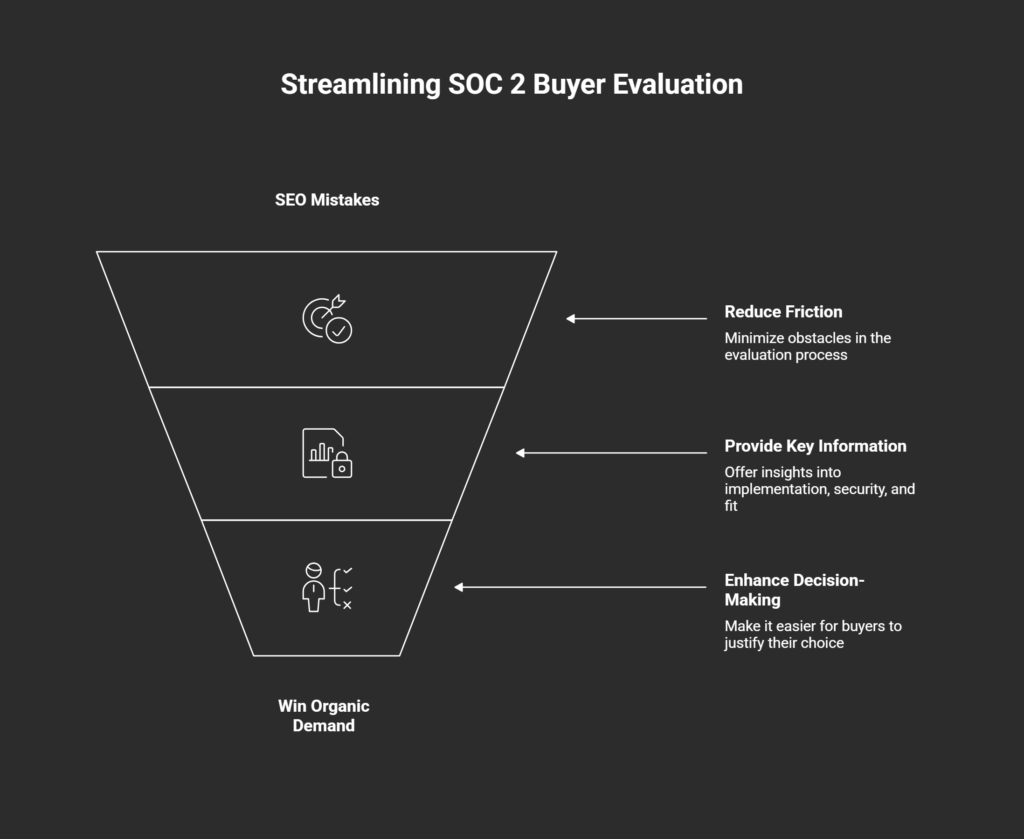
Fewer SEO mistakes won’t just improve rankings. They reduce friction in the evaluation process.
SOC 2 automation buyers rarely need more information. They need fewer unknowns. They want to understand implementation effort, security review readiness, and whether your product fits their operating model. The companies that win organic demand tend to be the ones that make those answers easy to find.
That’s the real goal of SEO in this category. Show up when evaluation is already happening, and make the decision feel easier to justify internally.