

What Businesses Usually Misunderstand About Lead Reactivation
A contractor spends thousands of dollars generating quote requests over the course of a year.
Some book.
Many don’t.
A few months later, the CRM is full of old estimates, missed calls, form submissions, and inquiries that never became customers.
Most business owners look at those records and assume the opportunity is gone.
That assumption drives many of the decisions local service businesses make about sales, marketing, and lead generation. More advertising gets purchased. More leads enter the pipeline. Meanwhile, hundreds of previous opportunities remain untouched.
The problem is that many businesses misunderstand what those old records actually represent.
Lead reactivation is often dismissed because of assumptions about customer behavior, follow-up, and database value that do not match what happens in the real world.
This article breaks down the most common misconceptions and explains why many businesses leave revenue sitting in their CRM without realizing it.
Key Takeaways: Lead Reactivation Misconceptions
- Many “dead leads” were never followed up long enough to reach a decision.
- Most follow-up systems stop earlier than the customer’s decision process.
- Buying more leads often increases pressure on an already under-managed pipeline.
- AI SMS works best as a consistency tool, not a replacement for sales.
- Silence does not automatically mean a prospect lost interest.
- Most CRM databases contain unfinished opportunities, not just historical records.
“Old Leads Are Dead Leads”
This is the most common misconception in lead reactivation.
A lead requests a quote, stops responding, and eventually gets labeled as lost.
Months later, nobody looks at it again.
The assumption is understandable. If someone did not move forward when they first reached out, it feels logical to assume they never will.
The reality is often less definitive.
Homeowners delay projects.
Budgets change.
Family decisions take time.
Contractors get compared.
Projects get postponed and revisited later.
Many businesses stop follow-up long before a customer finishes evaluating their options.
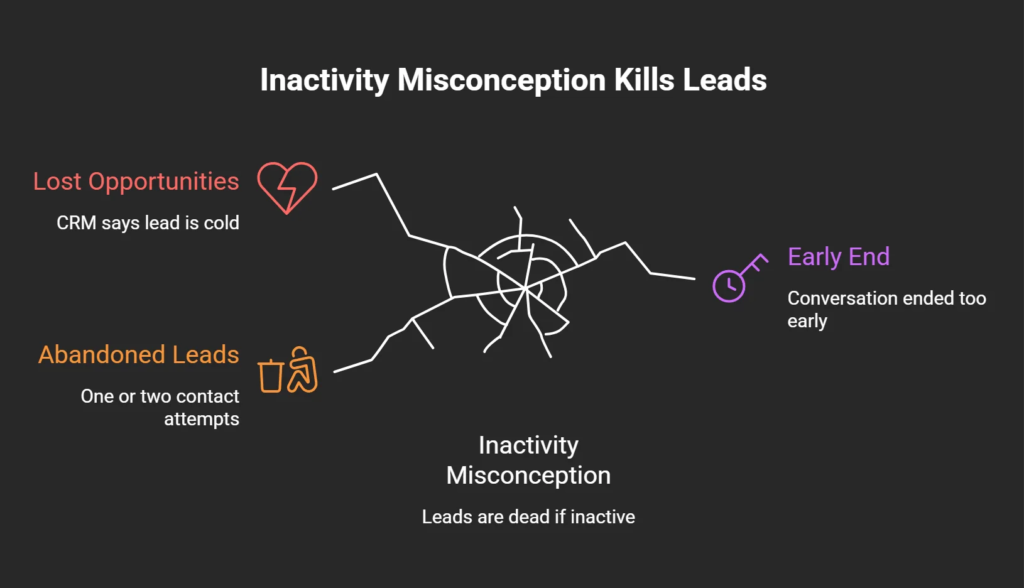
As a result, leads are often classified as dead based on inactivity rather than an actual decision.
When we review lead databases, it is common to find opportunities that received only one or two contact attempts before being abandoned.
The CRM says the lead is cold.
The contact history often says the conversation simply ended too early.
“A Few Follow-Ups Is Enough”
Most businesses follow up.
The issue is how long they continue.
A common pattern looks like this:
- Initial response
- One follow-up
- Another follow-up a few days later
- No response
- Lead becomes inactive
From the business perspective, significant effort was made.
From the customer’s perspective, the decision process may have barely started.
Many local service purchases involve:
- Comparing providers
- Reviewing budgets
- Coordinating schedules
- Waiting for approvals
- Delaying projects
Those decisions often take longer than the follow-up process itself.
This creates a gap where the business stops communicating while the prospect is still evaluating options.
One of the most consistent patterns we see is not poor follow-up quality. It is insufficient follow-up duration.
The conversation ends before the buying window closes.
“Buying More Leads Is Easier Than Fixing Follow-Up”
Buying more leads often feels like the fastest path to growth.
More advertising creates more activity.
More inquiries create the impression of momentum.
The problem is that many businesses continue adding leads to a process that is already leaking opportunities.
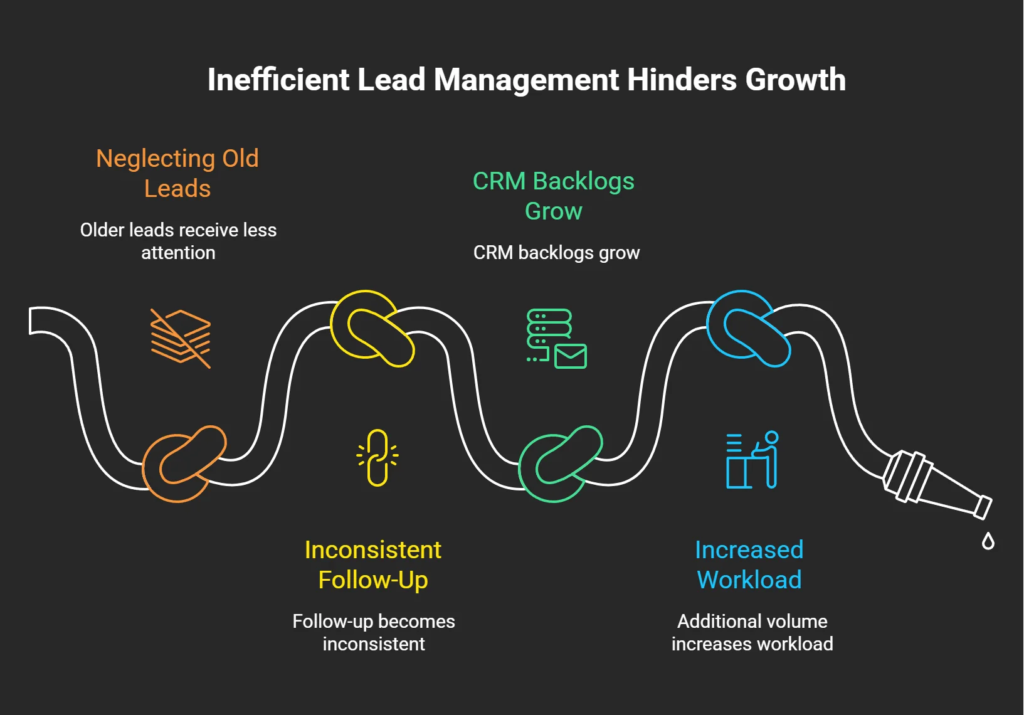
A familiar pattern develops:
- New leads arrive
- Older leads receive less attention
- Follow-up becomes inconsistent
- CRM backlogs grow
- More advertising is purchased
The business becomes busier without necessarily becoming more efficient.
When old quotes, missed calls, and unworked inquiries accumulate, additional lead volume frequently increases the workload without addressing the underlying issue.
Lead generation remains important.
But businesses that consistently leave opportunities unfinished often see stronger returns by improving lead management before increasing acquisition spend.
“AI SMS Replaces Salespeople”
Many business owners assume AI SMS falls into one of two categories.
Either it replaces sales entirely or it sends generic automated messages that customers ignore.
Neither assumption reflects how effective systems are typically used.
AI SMS is best understood as a follow-up layer.
Its role is to maintain communication when manual processes become inconsistent.
For example:
- Missed calls receive follow-up
- Old quotes receive check-ins
- Dormant inquiries get re-engaged
- Conversations restart when timing changes
The salesperson still handles qualification, appointments, estimates, and closing.
The system simply ensures opportunities do not disappear because nobody remembered to follow up.
At TTRAN, we view AI SMS as a consistency tool. Its value comes from maintaining communication across large numbers of leads that would otherwise receive little or no additional attention.
“If They Wanted It, They Would Have Responded”
This assumption sounds reasonable.
Unfortunately, customer behavior rarely works that cleanly.
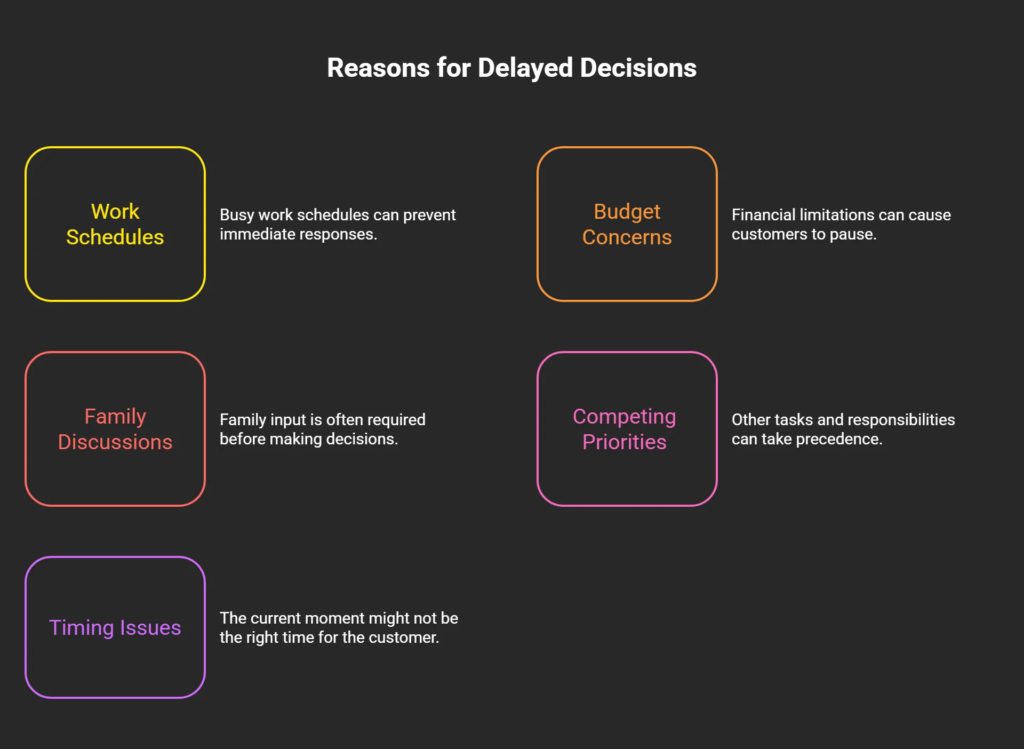
People delay decisions for countless reasons:
- Work schedules
- Budget concerns
- Family discussions
- Competing priorities
- Timing issues
Many still intend to move forward.
They simply do not do it immediately.
A lack of response often tells you very little about long-term intent.
Yet many businesses treat silence as a final answer.
Sales teams move on.
The lead receives no additional contact.
The opportunity gradually disappears from active attention.
In local service industries, silence often reflects a delayed decision rather than a rejected one.
The challenge is that businesses rarely discover which is true because communication stops before the answer becomes clear.
“Our Database Has Already Been Used”
Many businesses view their CRM as a record of what happened.
They rarely view it as a source of future revenue.
That perspective shapes how the database is managed.
Once a lead is marked:
- Lost
- Closed
- No response
- Not interested
it often disappears from future sales activity.
The record remains in the system, but nobody expects additional value from it.
This is one of the biggest misconceptions in lead management.
Most databases contain:
- Old estimate requests
- Missed calls
- Delayed decisions
- Unfinished conversations
- Leads that received limited follow-up
These contacts are frequently treated as historical data even though many still represent potential opportunities.
At TTRAN, we treat the CRM differently.
We see it as an inventory of conversations that may not have reached a conclusion.
That perspective changes how businesses evaluate marketing ROI, lead generation needs, and follow-up strategy.
Most misconceptions about lead reactivation come from how businesses interpret inactivity.
A lead stops responding, an estimate goes unanswered, or a project gets delayed, and the opportunity is treated as finished.
In many cases, the decision process never actually ended. The communication did.
That distinction matters because it affects how businesses allocate time, marketing budgets, and sales effort.
Before investing in additional lead generation, it is worth asking a different question:
How many opportunities already sitting in the CRM were never fully worked?
For businesses exploring ways to improve follow-up consistency and recover more value from existing inquiries, our AI automation and lead follow-up systems are designed to help keep conversations active long enough to reach a real outcome.