

What Happens to Leads After Hours?
A homeowner submits a roofing estimate request at 9:47 PM.
The business calls back at 8:15 AM the next morning.
From the company’s perspective, that seems reasonable.
From the homeowner’s perspective, the response came nearly eleven hours later.
By then, they may have already spoken with another contractor, scheduled an appointment, or crossed that company off their list entirely.
This disconnect is one of the most overlooked sources of lost revenue in local service businesses.
Leads continue arriving after business hours, but the follow-up process often stops when the office closes. Website forms sit in the CRM. Missed calls go to voicemail. New inquiries wait until someone starts work the next day.
Meanwhile, customers continue searching for solutions.
Understanding what happens to after-hours leads helps explain why some businesses struggle to convert inquiries even when lead volume appears healthy.
Key Takeaways: What Happens to Leads After Hours?
- After-hours leads often represent active buyers looking for immediate answers.
- Most revenue loss comes from delayed response rather than poor lead quality.
- Many businesses unknowingly pause their sales process overnight.
- Customers frequently contact multiple providers before business hours resume.
- A structured overnight response process helps preserve intent until a real conversation can happen.
- Businesses with strong lead generation often lose more revenue from after-hours gaps than they realize.
1. Why After-Hours Leads Matter More Than Most Businesses Realize
Many business owners assume after-hours inquiries are less valuable because they arrive when nobody is available to respond.
In practice, they are often some of the strongest opportunities in the pipeline.
A homeowner filling out a form at night, calling after dinner, or requesting an estimate outside normal working hours is usually trying to solve a real problem. These are not casual website visitors. They have already taken action.
The challenge is that most businesses treat these leads exactly the same as daytime inquiries.
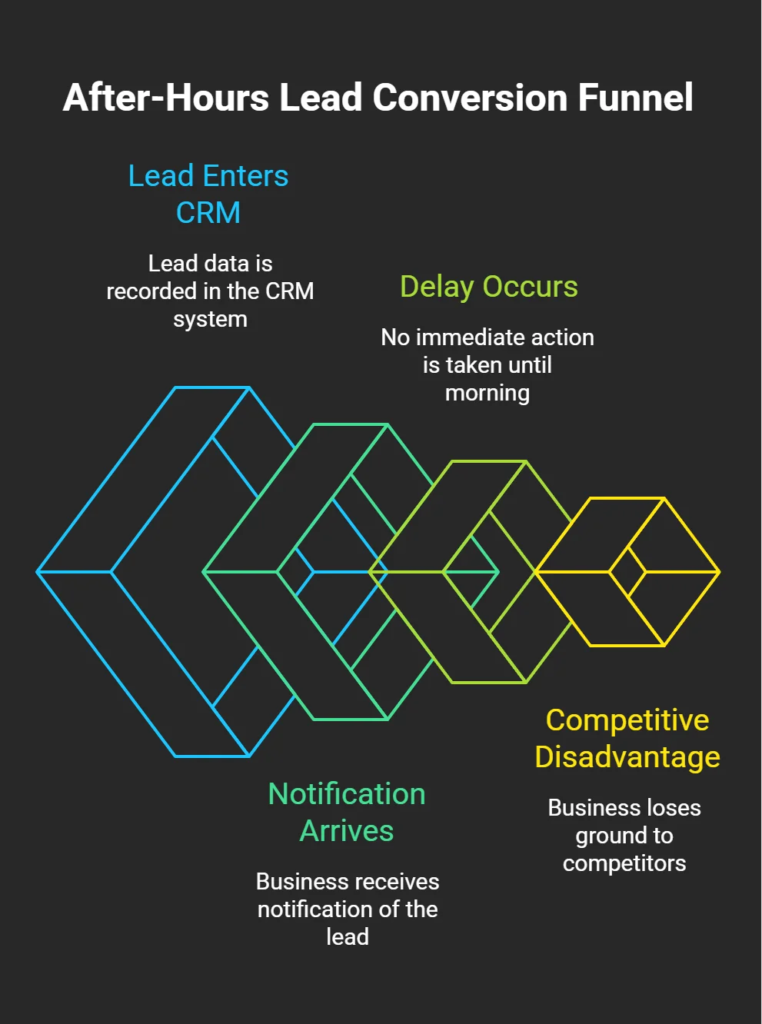
The lead enters the CRM.
The notification arrives.
Nothing happens until morning.
For service businesses such as roofing, HVAC, plumbing, legal services, and med spas, that delay creates a competitive disadvantage before the first conversation even begins.
The buying intent exists at the moment the lead submits the request. Every hour that passes without engagement reduces the likelihood that the business will be the one that ultimately wins the opportunity.
2. What Actually Happens to After-Hours Leads Overnight
Most after-hours leads follow one of three paths.
The first and most common outcome is that the customer speaks with someone else first.
A homeowner needing emergency plumbing service rarely submits a single request and waits patiently until morning. They continue searching until they find a provider who responds.
The second outcome is less obvious.
The lead remains available, but the urgency fades.
Someone requesting a quote late at night often does so because the problem feels immediate. By the next morning, daily responsibilities take over. Work starts. Kids go to school. Priorities shift.
The lead still exists, but the motivation that triggered the inquiry is weaker.
The third outcome is silence.
The customer does not reply when contacted the next day.
Many businesses interpret this as a low-quality lead.
In reality, the customer may have already chosen another provider or mentally moved on after receiving no response when they were actively looking.
This is why after-hours leads often underperform. The issue usually occurs before a sales conversation ever starts.
3. The Revenue Cost of Overnight Response Delays
Most businesses track lead volume.
Far fewer track response timing.
As a result, delayed after-hours leads often look identical to properly handled leads inside reporting systems.
The CRM shows both inquiries as received.
The conversion potential is very different.
A customer who receives a response within minutes remains engaged in the buying process. A customer who waits ten or twelve hours often reaches a decision before the conversation begins.
This is particularly noticeable in service categories where urgency influences buying behavior:
- Plumbing
- HVAC
- Roofing repairs
- Water damage restoration
- Emergency home services
In these industries, customers frequently choose the first provider who appears available and responsive.
The financial impact rarely appears as a single large loss.
Instead, it shows up through a steady stream of missed appointments, unreturned calls, and quote requests that never progress.
Over time, these small losses reduce the return on every advertising dollar already spent to generate the lead.
4. Why Most Businesses Still Struggle With After-Hours Follow-Up
The problem is usually operational rather than intentional.
Most sales processes are built around staff availability.
When the office closes, lead handling effectively stops.
Calls go to voicemail.
Website forms land in inboxes.
CRM notifications accumulate overnight.
The next morning introduces another challenge.
New leads arrive.
Customers call.
Appointments need scheduling.
After-hours inquiries become one item on a growing task list.
Many businesses assume those leads are already captured because they exist in the CRM.
From the customer’s perspective, however, the interaction has not started yet.
We regularly see businesses generating plenty of demand but lacking any defined process for what happens between the moment a lead arrives and the moment someone makes contact.
That overnight gap is where a significant percentage of opportunities lose momentum.
5. What Effective After-Hours Coverage Looks Like
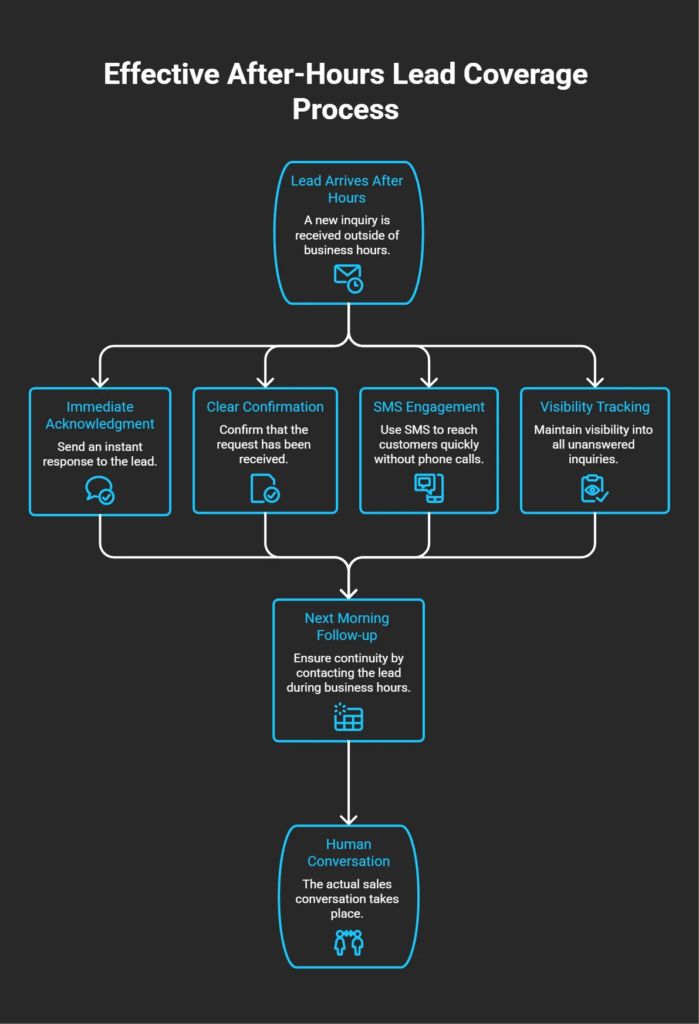
Effective after-hours coverage keeps the lead engaged until a real conversation can happen.
It does not require closing the sale at midnight.
It requires acknowledging the inquiry and maintaining continuity.
The strongest processes generally include:
- Immediate acknowledgment when a lead arrives
- Clear confirmation that the request was received
- Follow-up continuity the next morning
- Visibility into unanswered inquiries
This prevents leads from sitting silently for hours after expressing interest.
For many local service businesses, SMS works well because it reaches customers quickly without requiring them to answer a phone call late at night.
At TTRAN, we treat after-hours engagement as a continuity layer within the sales process. The purpose is preserving momentum during the period when staff are unavailable, not replacing the human conversation that happens later.
6. Why Businesses Consistently Underestimate After-Hours Leads
Most businesses evaluate leads based on source.
They look at:
- Google Ads
- SEO
- Referrals
- Directories
- Social media
What often gets overlooked is timing.
A lead that arrives at 2 PM and a lead that arrives at 10 PM may have very different buying behavior, even if they come from the same source.
After-hours leads frequently signal stronger urgency because customers are actively searching outside normal business routines.
The problem is that their value is difficult to see.
When those leads disappear, the loss rarely gets connected to response timing. Businesses often assume the lead was weak or unqualified.
In reality, many of those opportunities were high-intent prospects who simply never received engagement during the window when they were most likely to act.
That makes after-hours lead handling one of the most overlooked conversion opportunities in local service businesses.
After-hours leads rarely disappear because they lacked interest.
Most disappear because the buying process continued while the business was offline.
Customers compare providers, solve urgent problems, and make decisions long before many companies begin responding the next morning.
For businesses that generate a steady flow of inquiries, this creates a hidden conversion gap that often goes unnoticed inside CRM reports and lead dashboards.
If your business regularly receives website forms, missed calls, or quote requests outside normal operating hours, it may be worth reviewing what happens between the moment those inquiries arrive and the moment someone actually responds.
You can learn more about how TTRAN approaches this challenge through our AI automation services, which are designed to help businesses maintain lead engagement during the periods when manual follow-up is least consistent.