

5 Metrics Businesses Should Review Before Buying More Leads
A contractor spends another $2,000 on advertising because bookings feel inconsistent.
At the same time, there are 147 old leads sitting in the CRM, dozens of estimates that never received a second follow-up, and several missed calls from the past month that were never returned.
This situation is common across local service businesses.
When revenue feels unpredictable, the first instinct is often to generate more leads. More ads, more lead providers, more marketing spend. But additional lead volume does not automatically create more booked work.
Before increasing lead generation, it helps to understand how effectively the current pipeline is performing.
A business that converts and follows up consistently may benefit from more lead volume. A business with response delays, poor follow-up coverage, or weak conversion rates may simply be feeding more opportunities into an already leaky process.
The five metrics below help answer a simple question:
Do you need more leads, or do you need to get more value from the leads you already have?
Key Takeaways: Metrics Before Buying More Leads
- Cost per appointment reveals more than cost per lead because it measures actual sales opportunities.
- Lead-to-appointment conversion rate shows how effectively inquiries become booked conversations.
- Slow response times often reduce conversions before the sales process even begins.
- Close rate by source helps identify whether problems come from lead quality or lead handling.
- Follow-up coverage reveals how much of the database is actually being worked.
- Reviewing these metrics first can prevent businesses from increasing spend before fixing pipeline inefficiencies.
1. Cost Per Appointment Matters More Than Cost Per Lead
Many businesses focus heavily on cost per lead because it is easy to measure.
The problem is that leads do not generate revenue. Appointments do.
A campaign that produces inexpensive leads can still underperform if those inquiries rarely turn into scheduled estimates, consultations, or sales conversations.
Imagine two companies spending the same amount on advertising.
One generates cheap leads but struggles to get prospects on the phone. The other pays slightly more per lead but consistently converts those inquiries into appointments.
The second company usually generates more revenue even though its lead costs are higher.
Cost per appointment forces you to evaluate the entire process instead of only the marketing channel. It reflects response speed, follow-up quality, appointment-setting effectiveness, and sales execution.
Before increasing ad spend, determine how much you are paying for a booked conversation rather than simply measuring how much you are paying for a name, phone number, or form submission.
2. Lead-to-Appointment Conversion Rate
Lead-to-appointment conversion rate measures how many inquiries become scheduled appointments.
This metric helps determine whether the business is effectively turning interest into sales opportunities.
A low conversion rate often signals problems after the lead enters the pipeline.
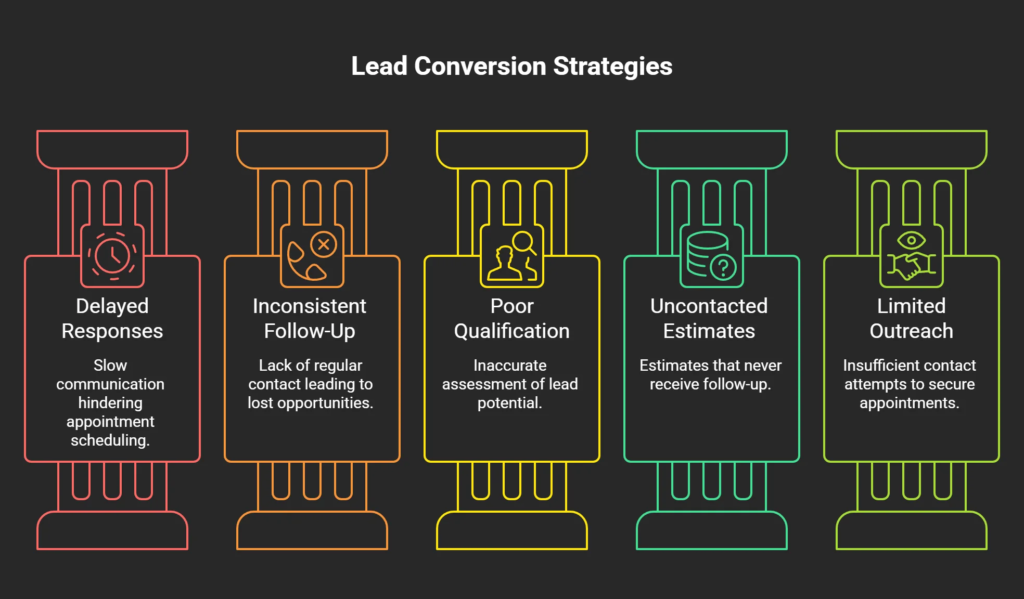
Common causes include:
- Delayed responses
- Inconsistent follow-up
- Poor qualification
- Estimates that never receive additional contact
- Leads that receive only one or two outreach attempts
Many owners assume low conversion means poor lead quality.
Sometimes that is true.
More often, however, leads enter the system and never receive enough communication to move forward.
Reviewing conversion rate helps identify whether the business is actually struggling to generate interest or struggling to convert interest that already exists.
If lead volume remains healthy while appointments remain flat, this metric deserves attention before additional marketing dollars are invested.
3. Speed-to-Lead Response Time
Response time measures how quickly a business contacts a prospect after an inquiry arrives.
This is one of the easiest metrics to understand and one of the easiest to overlook.
Many local service businesses respond quickly during slow periods and slowly during busy periods. Unfortunately, those busy periods are often when lead volume is highest and response speed matters most.
A homeowner requesting a roofing estimate may contact three companies within minutes.
A patient searching for a dentist may submit multiple inquiries before lunch.
A property owner needing emergency restoration work may call whoever answers first.
When leads wait hours or days for a response, conversion opportunities disappear before the sales process begins.
Review your actual response times rather than your intended response times.
Many businesses believe they respond quickly until they audit missed calls, website forms, and after-hours inquiries.
If response delays are common, adding more lead volume often increases the problem rather than solving it.
4. Close Rate by Lead Source
Most businesses receive leads from multiple channels.
These might include:
- Google Ads
- SEO
- Referrals
- Directories
- Past customers
- Reactivated leads
Looking at close rate by source helps determine which channels produce revenue rather than simply producing inquiries.
This metric is valuable because it separates assumptions from actual performance.
For example, a business may believe referrals are its strongest source because they feel easier to close. Meanwhile, another channel may quietly generate more revenue because those leads are followed up more consistently.
Close rate also helps identify operational problems.
If one source consistently underperforms, review how those leads are handled. Are they receiving the same follow-up? Are they being contacted as quickly? Are they being assigned and tracked properly?
Before shifting marketing budgets, make sure the differences reflect lead quality rather than inconsistent execution.
5. Follow-Up Coverage Rate
Follow-up coverage is one of the least tracked metrics and one of the most revealing.
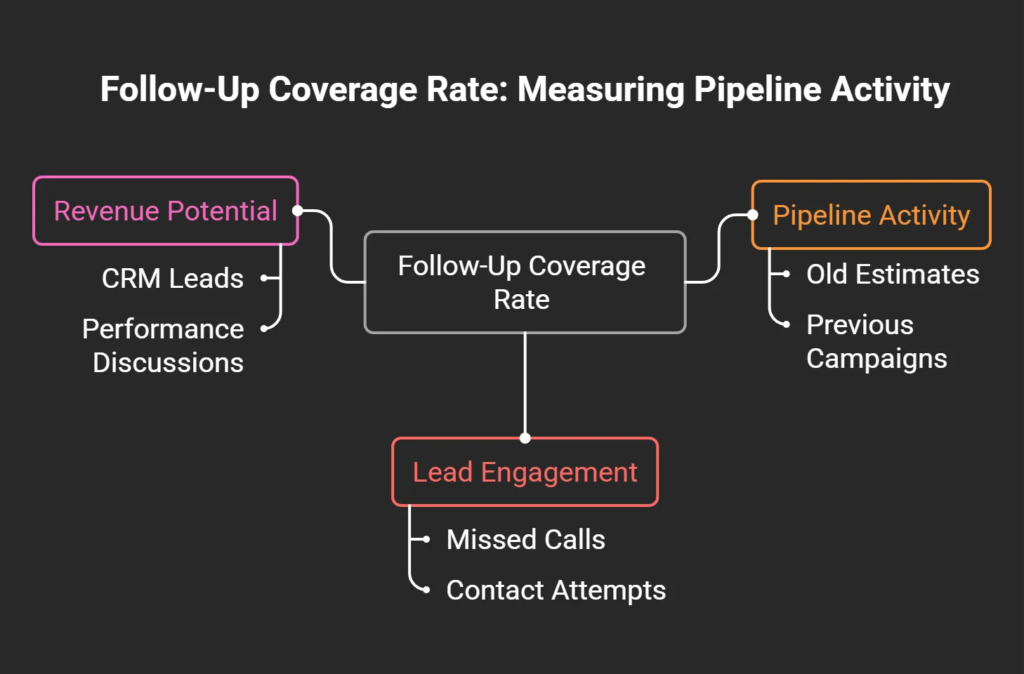
It measures how much of the pipeline is actually being worked.
Most businesses assume their team is following up with leads because calls are being made and messages are being sent.
The reality often looks different.
Old estimates sit untouched. Leads from previous advertising campaigns remain in the CRM for months. Missed calls never receive a callback. Prospects receive one or two contact attempts and then disappear from the active pipeline.
When we review lead databases, it is common to find large groups of leads that have received little or no recent outreach.
These leads are frequently excluded from performance discussions even though they represent potential revenue.
A follow-up coverage review helps answer an important question:
How many leads in your database are actively being worked today?
If the answer is “far fewer than expected,” increasing lead volume may simply create a larger backlog of unfinished opportunities.
Before buying more leads, determine whether the current pipeline is performing the way it should.
Cost per appointment, conversion rate, response speed, close rate by source, and follow-up coverage each reveal a different part of the sales process. Together, they show where opportunities are being lost before additional marketing spend enters the equation.
Many local service businesses discover that the biggest gains come from improving lead handling rather than increasing lead volume.
If missed calls, stale CRM records, unworked estimates, or inconsistent follow-up appear regularly in your business, it may be worth evaluating how those opportunities are being managed before investing in more lead generation.
For businesses looking to improve that process, our AI automation and lead follow-up systems are designed to help recover more value from the leads already in your pipeline.