

The Real Cost of Slow Response Times in High-Ticket Services
Most high-ticket service businesses believe they respond to leads reasonably well. Calls eventually get returned, quote requests are reviewed, and estimates are sent out.
The problem is that buyers do not experience response speed the way businesses do.
A roofing prospect requesting an estimate, a homeowner needing HVAC repairs, or a prospective legal client often contacts several companies within the same hour. While one business plans to respond later in the day, another has already started a conversation.
That gap quietly changes outcomes.
Slow response times in high-ticket services do more than delay conversations. They reduce the likelihood that a lead ever reaches the quoting, consultation, or closing stage.
Understanding where these delays come from—and what they actually cost—is often the first step toward improving conversion rates without generating a single additional lead.
Key Takeaways: Slow Response Times in High-Ticket Services
- High-ticket buyers typically contact multiple providers within a short period of time.
- Lead value falls when urgency fades, even if the lead remains interested.
- Response delays usually come from workflow issues, not lack of effort.
- Manual lead handling becomes less reliable as lead volume increases.
- Faster response improves initial engagement, but follow-up determines whether opportunities stay active.
- Many businesses lose revenue from leads they already paid to acquire.
Why Response Time Carries More Weight in High-Ticket Services
Response speed affects nearly every high-ticket industry because buyers rarely wait for a single company to get back to them.
Whether someone needs a roof replacement, legal representation, foundation repair, HVAC service, or a major remodeling project, they are usually collecting information quickly and comparing multiple providers.
Businesses often assume prospects will evaluate all options equally. In reality, the companies that respond first frequently become the first conversations, the first estimates, and the first appointments.
That early position matters.
When a prospect is actively researching, attention is limited. A business that responds quickly has an opportunity to answer questions, schedule a consultation, and establish credibility before competitors enter the discussion.
A delayed response can remove a business from consideration before pricing, reviews, experience, or service quality are ever evaluated.
This is why response speed directly influences revenue in high-ticket services. Before a business can compete on value, it has to enter the conversation while the buyer is still engaged.
What Happens When a Lead Waits Too Long
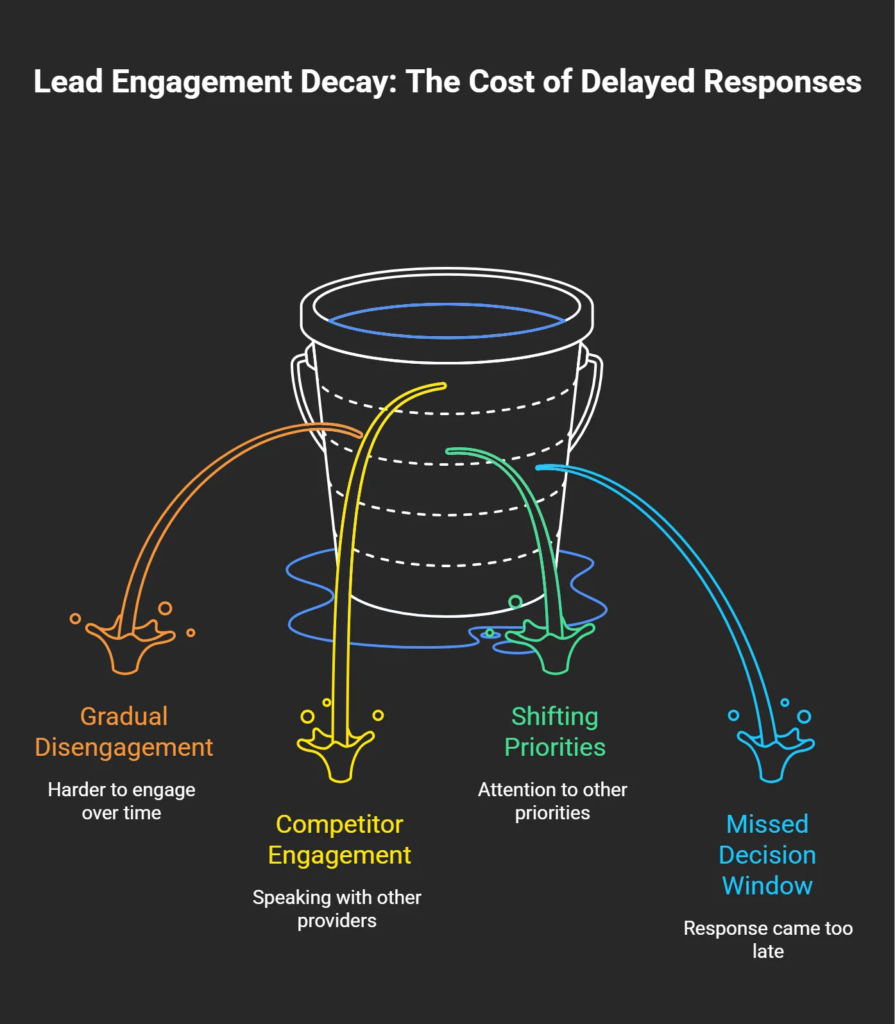
Most leads do not disappear immediately when a response is delayed.
Instead, they gradually become harder to engage.
A prospect who submits a quote request at 10:00 a.m. may still be interested at 10:15. By noon, they may already be speaking with other providers. By the following day, they may have scheduled appointments, received estimates, or shifted attention to other priorities.
The lead still exists, but the urgency that triggered the inquiry has weakened.
This is where many businesses misinterpret what happened.
A stale lead often gets labeled as unqualified or uninterested. In reality, the prospect may have been ready to talk when they first reached out but never received timely engagement.
We see this frequently when reviewing lead pipelines. Businesses assume lead quality declined when the real issue was timing. The inquiry arrived with strong intent, but the response came after the most important decision window had already passed.
For high-ticket services, the first hour after inquiry often carries more weight than businesses realize.
The Operational Causes Behind Slow Response Times
Most response delays come from normal business operations.
Leads arrive while technicians are on job sites. Owners are handling customers. Office staff are dealing with scheduling issues, paperwork, and ongoing projects.
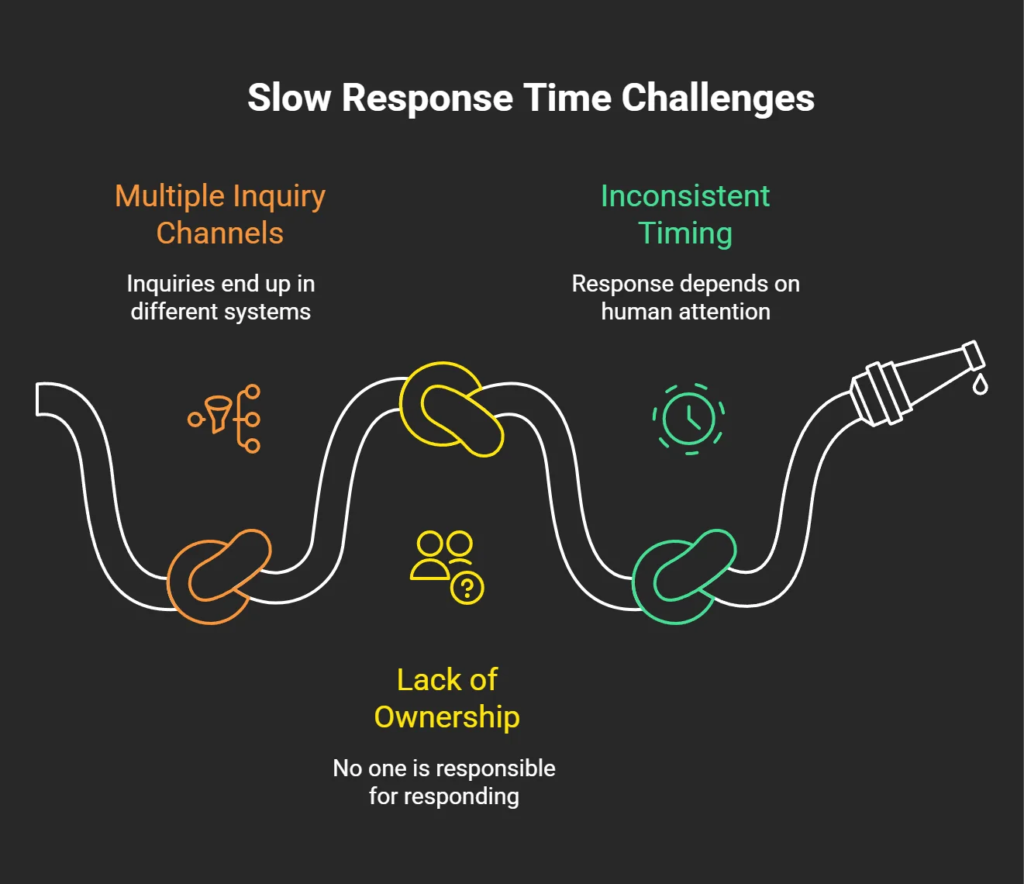
At the same time, inquiries arrive through multiple channels:
- phone calls
- website forms
- Google Ads
- local directories
- social media
- referral requests
Without a clear process, those inquiries can easily end up in different inboxes, notifications, and systems.
Another common issue is ownership.
A lead enters the business, but no one is specifically responsible for responding immediately. One team member assumes someone else handled it. A callback gets postponed until after a meeting. An estimate request sits unread until the end of the day.
Small delays accumulate quickly.
When response depends entirely on human attention, timing becomes inconsistent. Some prospects receive immediate follow-up while others wait hours simply because they arrived at a busy moment.
The businesses that respond consistently usually have a defined process between lead capture and lead contact rather than relying on memory or availability.
The Revenue Impact of Slow Response
The financial impact of slow response times is rarely visible on a profit-and-loss statement.
Instead, it appears as lower conversion rates.
A business may generate the same number of leads every month while booking fewer consultations, fewer estimates, and fewer jobs. Owners often attribute this decline to lead quality, seasonality, competition, or marketing performance.
Response delays are frequently overlooked.
When engagement starts late, sales teams must work harder to recover attention. More calls go unanswered. More follow-up attempts are required. More prospects disappear before meaningful conversations begin.
This affects every lead source.
If a business pays for advertising, every missed opportunity reduces the return generated from that spend. The cost per lead stays the same while the number of customers produced from those leads declines.
Over time, businesses compensate by purchasing more leads instead of improving how existing inquiries are handled.
We view this as a lead-handling problem rather than a lead-generation problem. The inquiry already exists. Revenue is lost between the moment the lead arrives and the moment meaningful contact occurs.
Fast Response Still Needs Consistent Follow-Up
Responding quickly improves engagement, but it does not complete the sales process.
High-ticket purchases often involve multiple conversations, comparisons, approvals, and delays.
A homeowner collecting remodeling estimates may take weeks to decide. A legal prospect may need time to evaluate options. A business owner considering a large project may not be ready to commit after a single conversation.
Many leads go quiet after initial contact.
This is where businesses often lose momentum.
The first response happens quickly, but follow-up becomes inconsistent. Sales teams prioritize new inquiries. Older conversations move down the list. Estimate requests receive one or two attempts and then stop receiving attention.
As a result, leads that began with strong interest slowly disappear from the pipeline.
Response speed creates the opportunity. Consistent follow-up keeps the opportunity active long enough for a buying decision to happen.
Businesses that improve both areas generally see more stable conversion performance than those focused only on response speed.
Why Most Fixes Break Down
When owners recognize a response problem, the first solution is usually more effort.
Someone gets assigned to monitor leads. Internal response targets are established. Teams are reminded to call people back faster.
These changes often work temporarily.
The challenge is that workload never stays consistent.
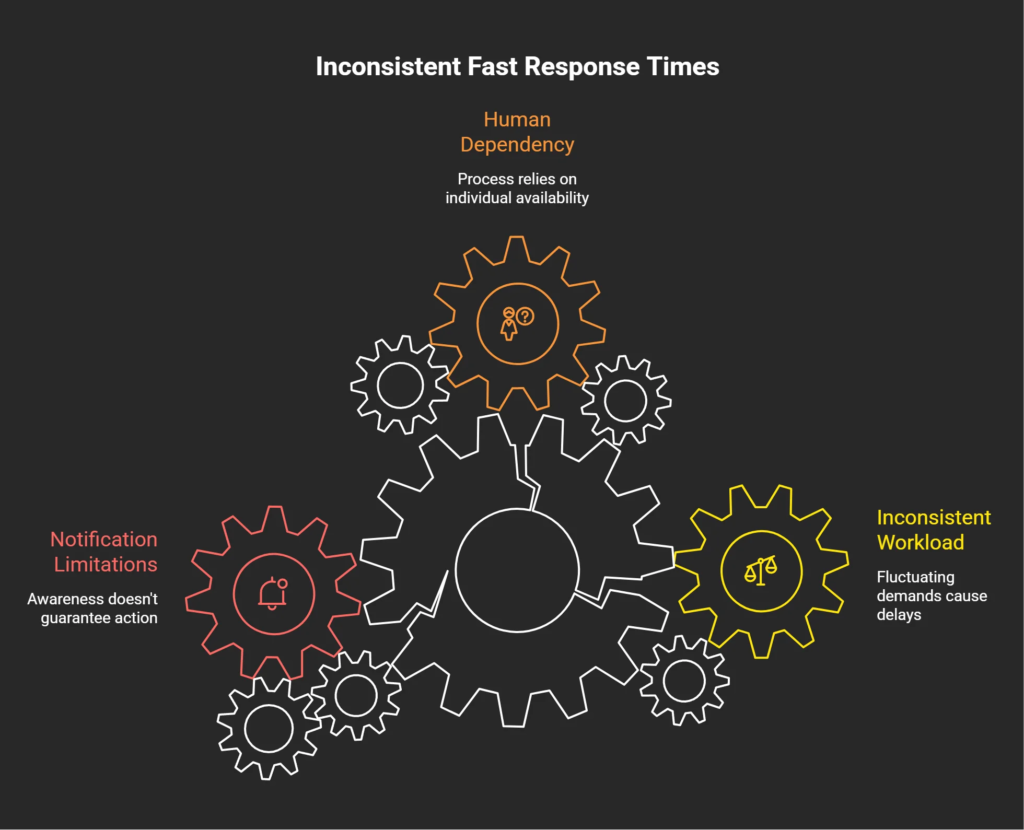
Busy periods, employee absences, job-site demands, after-hours inquiries, and fluctuating lead volume eventually create the same delays again. The process still depends on people being available at exactly the right moment.
Notification systems create a similar issue. They improve awareness but do not guarantee action.
A lead can be seen, acknowledged, and still wait several hours before receiving a response.
The businesses that maintain fast response times over the long term usually rely on systems that support consistent execution rather than individual effort alone.
When response depends entirely on human availability, delays eventually return under normal operating conditions.
Slow response times create costs that most high-ticket service businesses never directly measure.
The impact appears in lower conversion rates, stalled conversations, unanswered quote requests, and opportunities that quietly move to competitors.
Many owners assume they need more leads when the bigger opportunity is improving how existing inquiries are handled.
If your business regularly deals with missed calls, delayed callbacks, estimate requests that sit untouched, or leads that go cold after initial contact, response speed deserves attention.
At TTRAN, we often start by examining how quickly leads are contacted and what happens after that first interaction. Businesses that improve those two areas frequently uncover revenue opportunities that were already sitting in their pipeline long before they spent another dollar on marketing.