

How to Know Whether Your Business Is Ready for Lead Reactivation
Most local service business owners assume they need more leads.
More advertising. More traffic. More inquiries.
Sometimes that’s true. But many businesses already have opportunities sitting inside their CRM, inbox, call logs, or estimate pipeline that never reached a final outcome.
A quote was sent but never accepted. A prospect stopped responding after the first conversation. A missed call never received meaningful follow-up. New leads arrived and attention shifted elsewhere.
Over time, those unfinished conversations accumulate.
We see this regularly across contractors, home service companies, med spas, dental practices, legal firms, and other appointment-driven businesses. Revenue is often lost after the lead enters the system, not before.
This article is designed to help you answer a practical question:
Does your business already have enough unused opportunity to justify a lead reactivation system, or are there more fundamental issues that need attention first?
Key Takeaways: Is Your Business Ready for Lead Reactivation?
- Old leads, unsold quotes, and inactive inquiries are often the strongest indicators of reactivation potential.
- Follow-up breakdowns typically create more lost revenue than most businesses realize.
- Businesses that generate leads but do not track long-term outcomes often have hidden opportunities in their CRM.
- A heavy reliance on new leads usually indicates existing opportunities are not being fully worked.
- Unsold estimates are frequently one of the highest-value reactivation targets.
- Lead reactivation works best when basic lead tracking and response systems already exist.
What “Ready for Lead Reactivation” Actually Means
A business is ready for lead reactivation when it has existing opportunities that never reached a clear conclusion.
That does not require a massive database or a sophisticated CRM.
It simply requires a history of real prospects who showed interest and then disappeared from active follow-up.
Examples include:
- estimate requests that never moved forward
- consultations that were never booked
- prospects who stopped responding
- leads marked “no answer”
- inquiries sitting inactive in the CRM
The common factor is that no final decision was made.
These are not random contacts. They are people who entered the sales process and then fell out of it.
At TTRAN, readiness starts with a simple question:
Do you already have names, phone numbers, estimate requests, or inquiries from people who once showed interest but never became customers?
If the answer is yes, there is usually something worth reactivating before spending additional money generating new demand.
Sign #1: You Have Leads That Never Reached a Final Outcome
This is the strongest indicator of readiness.
Many businesses have leads that received one or two follow-up attempts and then disappeared.
Nobody said no.
Nobody formally declined.
The conversation simply stopped.
We often see:
- quotes that never received another touch
- prospects who stopped replying after pricing was sent
- consultations that were never scheduled
- inquiries that received a voicemail and nothing else
These opportunities frequently get labeled as cold even though the buying decision was never completed.
From an operational standpoint, they are unfinished sales conversations.
If your business has a history of leads that entered the pipeline but never reached a clear yes or no, you already have a strong case for lead reactivation.
Those records represent demand that was created but never fully worked.
Sign #2: You Generate Leads but Don’t Track What Happens Afterward
Many businesses know exactly how many leads they generate.
Far fewer know what ultimately happened to those leads.
They track:
- cost per lead
- advertising spend
- inquiries generated
But they do not consistently track:
- number of follow-up attempts
- response rates over time
- quote acceptance rates
- re-engagement activity
- eventual conversion outcomes
As a result, opportunities often get marked as lost without being fully evaluated.
This creates a blind spot.
A lead enters the system, receives limited follow-up, and disappears from reporting. Months later, nobody knows whether the lead was truly unqualified or simply stopped receiving attention.
When businesses invest consistently in lead generation but lack visibility into long-term conversion outcomes, there is usually untapped value sitting inside the pipeline.
That makes lead reactivation highly relevant.
Sign #3: New Leads Always Get Priority
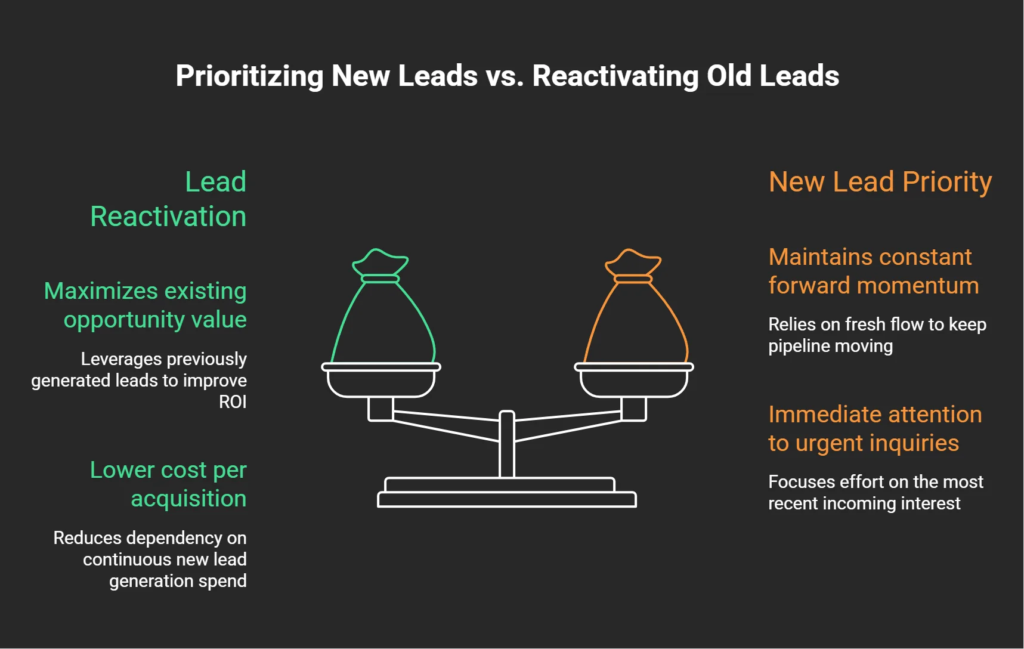
Many businesses operate in a cycle where attention constantly shifts toward the newest inquiry.
That behavior is understandable.
New leads feel urgent.
Old leads feel uncertain.
The result is a pipeline that continuously moves forward without looking back.
We commonly see situations where:
- today’s inquiries receive immediate attention
- last week’s leads receive limited follow-up
- last month’s opportunities are forgotten entirely
Over time, the CRM becomes more of an archive than a working sales tool.
This creates an imbalance.
The business continues paying to generate new opportunities while older opportunities remain untouched.
If your sales process depends almost entirely on fresh lead flow and rarely revisits previous conversations, lead reactivation is often one of the highest-leverage improvements available.
Sign #4: You Have Unsold Quotes Sitting in the System
Unsold estimates are one of the clearest signs that a business is ready for lead reactivation.
These are not casual inquiries.
The prospect already:
- contacted the business
- discussed their needs
- requested pricing
- entered the buying process
Yet many estimates receive minimal follow-up after they are delivered.
A reminder gets sent.
A voicemail gets left.
Then the opportunity quietly disappears.
We regularly find unsold quotes sitting inside CRMs marked as:
- pending
- no response
- estimate sent
- follow-up needed
These records often represent some of the highest-intent opportunities inside the business.
The prospect already invested time in the process. The challenge is usually maintaining engagement long enough for a decision to happen.
For many service businesses, unsold quotes are among the most valuable reactivation targets available.
When Your Business Is Not Ready for Lead Reactivation
Lead reactivation is not always the next priority.
Some businesses need to address more fundamental issues first.
The clearest examples include:
No Lead Records
If leads are not being stored anywhere consistently, there is nothing reliable to reactivate.
Extremely Low Lead Volume
A business generating only a handful of inquiries each month may not have enough historical opportunity to justify a dedicated reactivation effort.
Current Leads Already Go Unanswered
If today’s leads are waiting hours or days for a response, adding old leads into the mix usually creates more pressure on an already strained process.
In these situations, improving lead capture, response speed, and basic follow-up discipline typically comes before reactivation.
Quick Self-Assessment
Ask yourself the following:
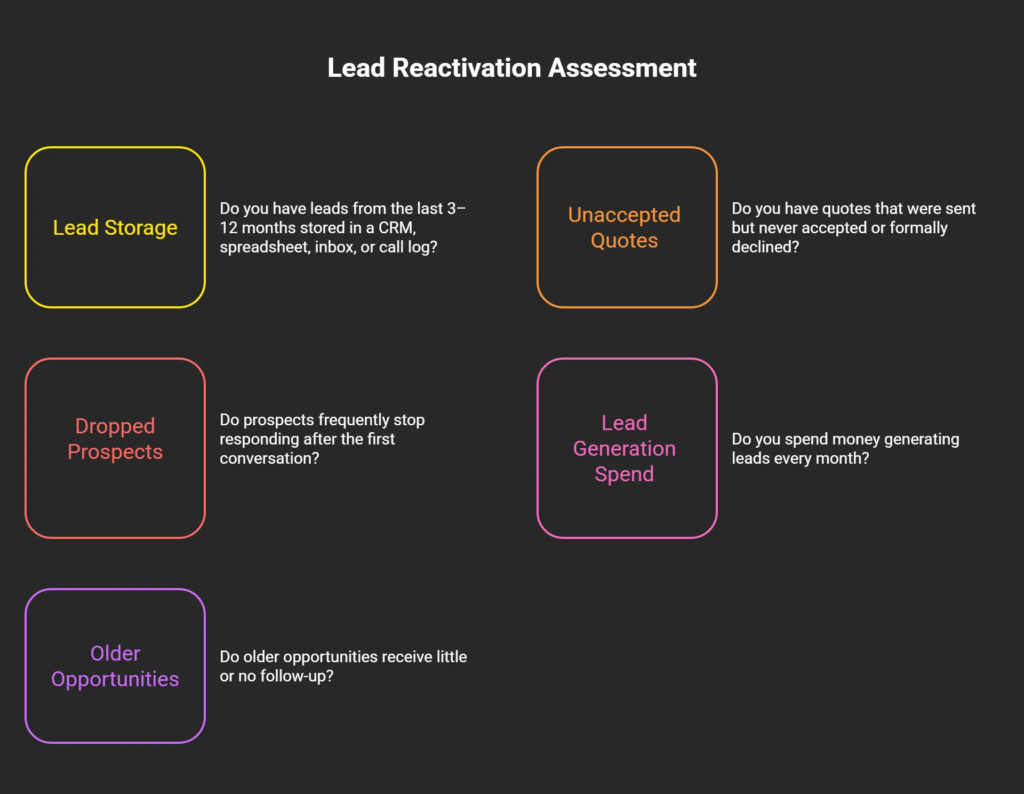
- Do you have leads from the last 3–12 months stored in a CRM, spreadsheet, inbox, or call log?
- Do you have quotes that were sent but never accepted or formally declined?
- Do prospects frequently stop responding after the first conversation?
- Do you spend money generating leads every month?
- Do older opportunities receive little or no follow-up?
Every “yes” suggests there may already be dormant opportunities inside your business.
Most owners underestimate how much opportunity exists until they actually review their records.
A few months of steady lead flow can easily create hundreds of inactive contacts, estimate requests, and stalled conversations that were never fully worked.
Readiness is less about business size and more about whether those opportunities already exist.
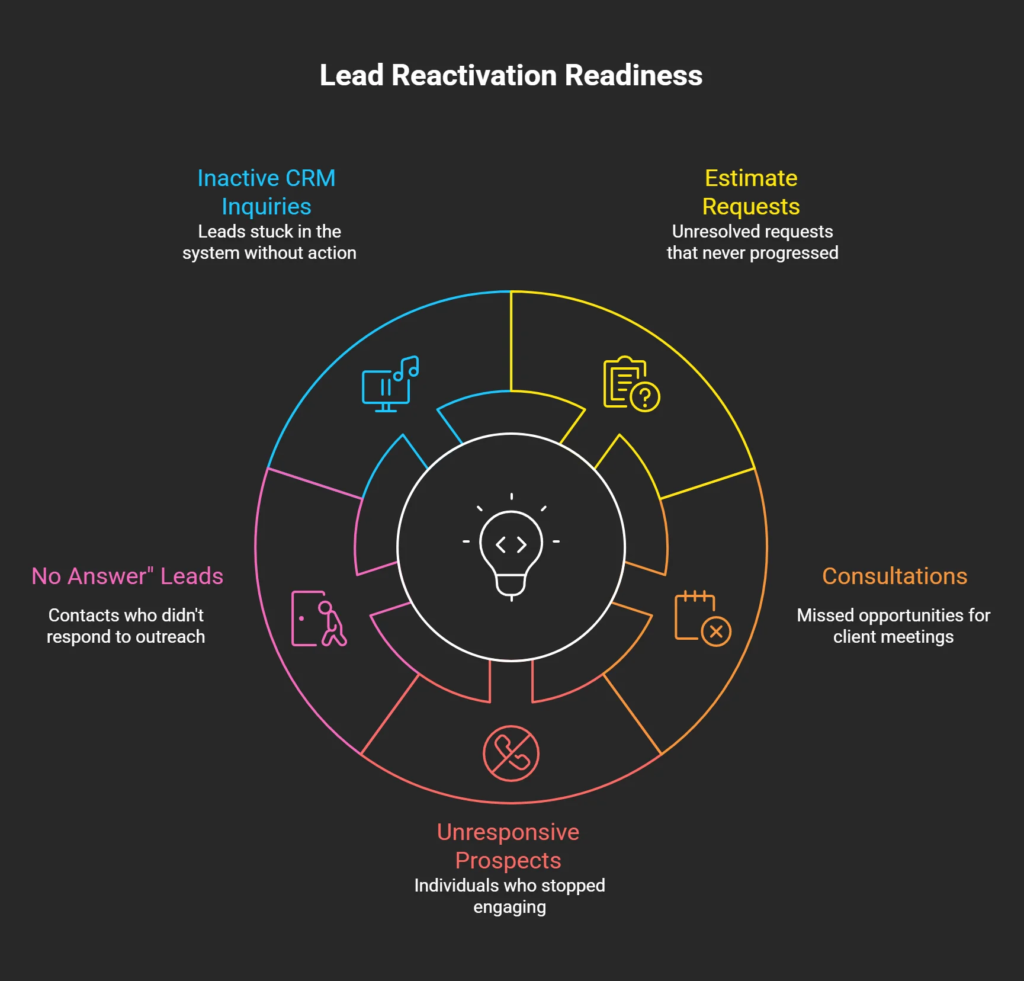
A business is ready for lead reactivation when it has a backlog of real opportunities that never reached a final decision.
Those opportunities often appear as:
- inactive CRM records
- unsold estimates
- unanswered inquiries
- stalled conversations
- leads that quietly disappeared from follow-up
The common thread is that the sales process stopped before the opportunity was fully exhausted.
At TTRAN, we view lead reactivation as a recovery layer built on top of demand that already exists. If your business has a history of leads, quotes, or conversations that were never fully worked, the opportunity may not be finding more leads. It may be reconnecting with the ones you already paid to acquire through a structured lead reactivation system.