

SEO for SOC 2 Automation & Compliance Software Companies
Why SEO Works Differently for SOC 2 Automation Software
SOC 2 automation software is not a casual purchase. It sits at the intersection of security, compliance, sales velocity, and executive risk. When a buyer evaluates vendors in this category, they are not looking for growth hacks or surface-level explanations. They are trying to reduce uncertainty around an expensive, high-impact decision.
That reality changes how SEO works.
Most buyers already understand what SOC 2 is. Many have lived through an audit or are feeling pressure from enterprise customers. They are educated, skeptical, and alert to vague claims. Every marketing asset they touch is quietly judged as a signal of credibility or lack thereof. SEO content is no exception.
In this market, SEO is less about attracting attention and more about showing up at the right moment with the right kind of clarity. The goal is not volume. It is presence during evaluation.
A typical SOC 2 automation buying motion looks very different from generic SaaS:
- Deal sizes are meaningful enough to justify scrutiny
- Sales cycles stretch across weeks or months
- Buying committees include founders, security leaders, and finance
- Decisions are reviewed internally before anyone books a demo
Because of this, generic “SaaS SEO” advice tends to fail. Tactics built around top-of-funnel traffic, broad educational posts, or keyword volume ignore how trust is formed here.
The table below highlights the difference:
| Generic SaaS SEO | SOC 2 Automation SEO |
| Optimize for traffic | Optimize for credibility |
| Broad education | Evaluation-stage clarity |
| Marketer-led discovery | Cross-functional scrutiny |
| Fast conversion | Risk-aware decision-making |
Key Takeaways
- SEO for SOC 2 automation software works best when it targets evaluation-stage searches, not broad compliance education.
- The highest-impact pages are usually comparisons, alternatives, and “do we need this?” content because they influence shortlists and internal decisions.
- Many of the best keywords will show low or zero volume, but still drive pipeline because they reach buyers mid-decision.
- In this niche, SEO is less about traffic and more about trust, clarity, and risk reduction for skeptical buying committees.
- Authority isn’t just backlinks. It’s the ability to publish content that feels defensible, specific, and useful in a high-stakes category.
- The goal is a decision-support library that shortens sales cycles and improves lead quality over time.
How SOC 2 Automation Buyers Actually Search
After understanding why SEO plays a different role in this market, the next mistake is assuming SOC 2 automation buyers search the way keyword tools suggest they should.
They don’t.
The most valuable searches in this category happen late in the funnel, often after internal discussions have already started. By the time someone opens Google, they are usually validating a direction, comparing options, or trying to reduce perceived risk. These searches are few, specific, and commercially decisive. Many show little or no volume in tools, yet they directly influence pipeline.
SOC 2 automation buyers tend to search in a small number of predictable modes:
- Evaluation and validation
Questions that test whether automation is the right path at all.
Example: “Is SOC 2 automation worth it?” - Comparison and alternatives
Searches used to narrow a shortlist or justify a recommendation internally.
Example: “Vanta alternatives for startups” - Risk, credibility, and trust confirmation
Queries that surface concerns around scope, security posture, or audit readiness.
Example: “Do we need SOC 2 automation or a consultant?”
What matters is not how often these searches happen, but who is making them and why.
Founders, security leaders, and heads of compliance search very differently than marketers. Their goal is not discovery. It is decision support.
This is why volume-based SEO breaks down in SOC 2 automation. A keyword with ten searches per month can be more valuable than one with ten thousand if it consistently reaches buyers who are already close to choosing a vendor.
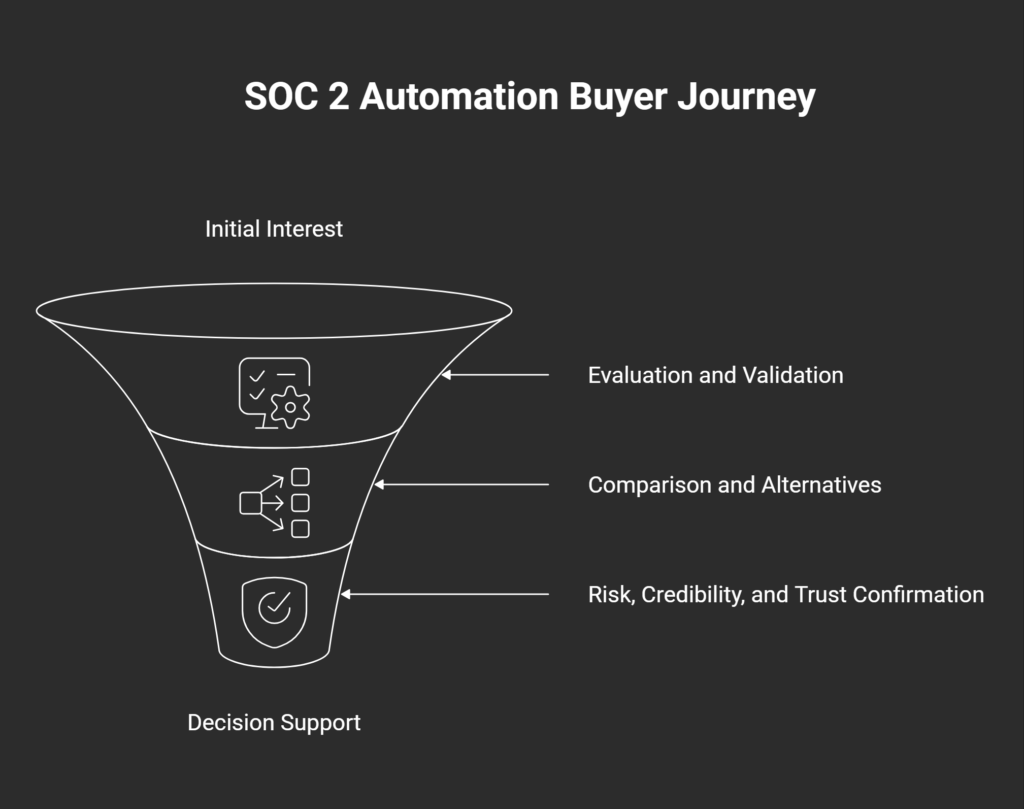
Effective SEO in this space starts by modeling buyer psychology, not by exporting a list from a tool. When content aligns with how these buyers actually evaluate software, search becomes a quiet but reliable way to enter the conversation at exactly the right time.
Bottom-of-Funnel SEO Strategy for SOC 2 Automation SaaS
Once you accept that SOC 2 automation buyers search late and narrowly, the strategy becomes clearer. SEO here is not a traffic engine. It is a revenue-aligned acquisition channel designed to support active buying motions.
Bottom-of-funnel SEO focuses on content that shows up when a decision is already forming. The intent is commercial, even if the query doesn’t look that way on the surface. These pages influence shortlists, internal debates, and whether a buyer feels confident moving forward.
What “bottom-of-funnel” actually means in compliance software
In SOC 2 automation, bottom-of-funnel does not mean “ready to buy tomorrow.” It means the buyer is past education and into evaluation. They are pressure-testing assumptions and looking for reasons to say yes or no.
This is where informational content and decision content diverge.
| Informational content | Decision content |
| Explains what SOC 2 is | Evaluates how to achieve it |
| Answers curiosity | Reduces decision risk |
| Broad audience | Specific buyer profile |
| Early-stage | Late-stage |
Informational content can build awareness, but it rarely moves a deal forward. Decision content, by contrast, mirrors the questions sales teams hear every week.
For SOC 2 automation SaaS, this usually means prioritizing four content types:
- Comparison pages
Side-by-side evaluations that help buyers justify a shortlist. - Alternatives pages
Content designed for buyers who are already aware of a market leader but want to sanity-check other options. - Use-case-driven content
Pages that speak to specific contexts, such as early-stage startups, enterprise sales pressure, or audit timelines. - Objection-handling articles
Content that addresses common hesitations before they stall a deal.
Mapping content to real sales objections
Effective BOFU SEO starts with sales conversations, not keyword lists. Every strong page should map to a real objection or internal question a buyer needs to resolve.
Examples include:
- “Is automation overkill for our size?”
- “Will this satisfy enterprise customers?”
- “How does this compare to hiring a consultant?”
- “What risks does automation introduce?”
When these questions are answered clearly and credibly in search, SEO stops competing with sales. It supports it.
The result is not more leads, but better ones. Buyers arrive informed, aligned, and already familiar with the tradeoffs. That is what makes bottom-of-funnel SEO a pipeline lever rather than a blogging exercise.
The Content Types That Drive Pipeline
If bottom-of-funnel SEO is the strategy, the next question is practical: what should you actually publish?
In SOC 2 automation, the content that drives pipeline tends to cluster into a few repeatable categories. Each one maps to a specific evaluation behavior. Together, they form a system that supports real buying decisions.
Comparison & Alternatives Content
This is usually the highest-impact category because it aligns with the moment buyers are narrowing options.
By the time someone searches “X vs Y” or “X alternatives,” they are not learning. They are selecting.
Buyers use these pages to:
- sanity-check what sales told them
- pressure-test vendor positioning
- gather language for internal justification
- build a shortlist without scheduling more calls
The trust requirement is high. If the page reads like a hit piece or a disguised landing page, it fails. The goal is not to “win” the comparison. The goal is to be the most credible guide in the room.
A simple rule: write about competitors the way you would want them to write about you.
That means being specific about tradeoffs, acknowledging where another tool may be a better fit, and avoiding vague claims that can’t be verified.
Use-Case & Segment-Specific Pages
SOC 2 automation is not one market. The buyer context changes the evaluation criteria.
A startup under enterprise pressure is solving a different problem than a mid-market company formalizing compliance. An enterprise team may care more about integrations, governance, and evidence workflows than speed alone.
Segment-specific pages help buyers self-identify quickly:
- Startups: speed, simplicity, readiness, cost sensitivity
- Mid-market: repeatable process, stakeholder alignment, scale
- Enterprise: controls maturity, governance, audit defensibility
It also helps to write for who leads the evaluation:
- Engineering-led buyers often prioritize workflow fit, integrations, and friction
- Compliance-led buyers often prioritize audit readiness, reporting, and defensibility
These pages reduce bounce risk because they answer the unspoken question: “Is this built for a team like ours?”
“Do We Need This?” Content
Not every buyer is convinced they should use SOC 2 automation software at all. Many are still deciding between paths.
This content addresses timing, readiness, and build-vs-buy tension.
Common decision splits include:
- Automation vs consultants
- In-house process vs software
- Do it now vs wait until customer pressure forces it
These pages don’t need to persuade everyone. They need to help qualified buyers make a confident call and disqualify the wrong-fit ones without friction.
Credibility & Risk Content
In a trust-heavy category, buyers look for signals that reduce perceived risk. They want to know what happens when things go wrong, not just when things go smoothly.
Credibility content often centers on:
- security posture and how data is handled
- evidence workflows and access controls
- audit readiness and what “ready” actually means
This is not about writing a security whitepaper. It is about answering the questions buyers ask when they are close to committing but still cautious.
A useful way to think about the content mix is intent coverage:
| Content type | Buyer intent it serves |
| Comparisons & alternatives | Shortlisting and vendor selection |
| Use-case & segment pages | “Is this for a team like ours?” |
| “Do we need this?” pages | Readiness and path selection |
| Credibility & risk pages | Trust and internal approval |
When you publish across these four categories, you stop blogging “about SOC 2” and start building a decision-support library. That’s what drives pipeline in this space.
Authority, Trust, and the Reality of Ranking in a High-Trust Niche
At this point, a reasonable concern is: Can we actually rank for any of this?
SOC 2 automation is a high-trust niche. Many SERPs are crowded with high-DR sites, established vendors, and security publications. It’s easy to look at backlink counts and assume the game is over.
But DR and backlink volume are incomplete signals. They tell you something about a domain’s history, not whether a specific page is the best match for a buyer’s search intent.
In regulated and trust-sensitive spaces, Google has a clear incentive: surface results that reduce user risk. That doesn’t always mean “the biggest site wins.” It often means the most useful, specific, and defensible answer wins.
In practice, newer or smaller vendors can compete when their content does three things well:
- Matches the real decision being made
Not “what is SOC 2,” but “which approach is right for our team?” - Shows expertise through clarity
Precise language, realistic tradeoffs, and no filler. - Respects the buyer’s skepticism
No exaggerated claims, no vague promises, no pretending every company is a fit.
This is why generic content tends to underperform. It’s written to rank broadly, not to help someone choose. In this category, buyers are not looking for more information. They’re looking for fewer unknowns.
It also helps to define what “authority” actually looks like for SOC 2 automation companies. It’s not just links. It’s the sum of signals that tell a buyer, this vendor understands the job we’re hiring them to do.
That authority usually shows up as:
| Authority signal | What it communicates to buyers (and search engines) |
| Clear comparison and alternatives pages | You understand the market and your position in it |
| Use-case and segment clarity | You know who you’re built for (and who you’re not) |
| Risk and audit-readiness content | You take trust seriously and can explain the hard parts |
| Consistent decision-focused writing | You’re not here to generate clicks—you’re here to reduce uncertainty |
The takeaway is simple: in SOC 2 automation SEO, you don’t win by being louder. You win by being more specific, more credible, and more aligned with how buyers actually evaluate.
Common SEO Mistakes SOC 2 Automation Companies Make
Even teams that understand SEO often get it wrong in SOC 2 automation. Not because they’re careless, but because most SEO playbooks were built for lower-trust markets with simpler buying decisions.
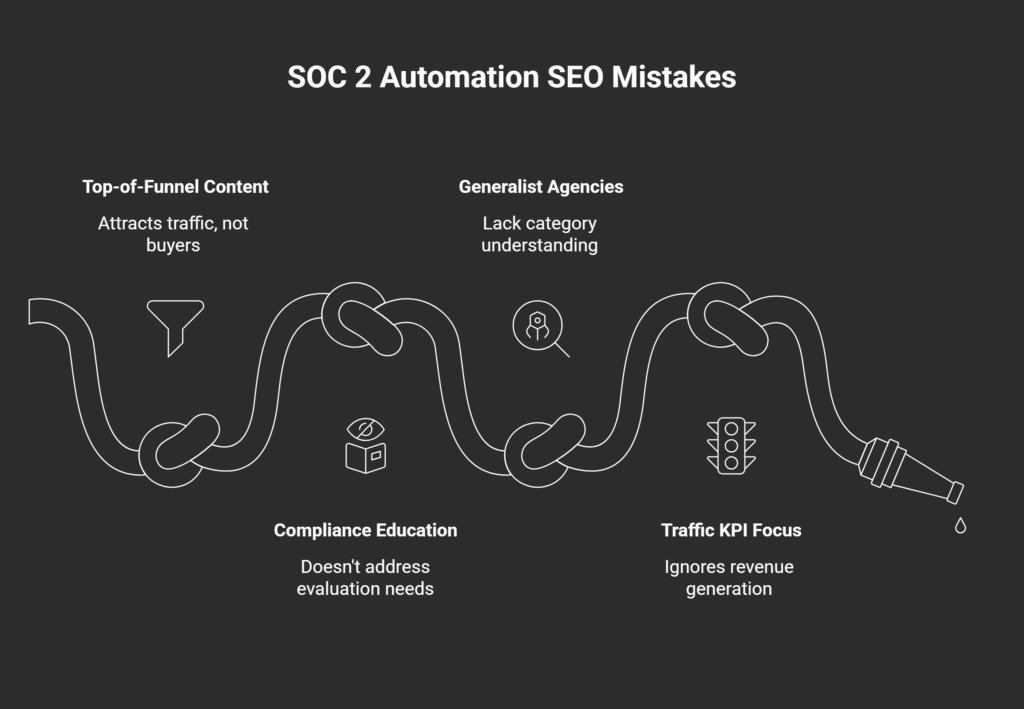
Here are the mistakes that show up most often.
1) Chasing top-of-funnel content that never converts
It’s tempting to publish broad posts like “What is SOC 2?” or “SOC 2 checklist.” They can attract traffic. They rarely attract buyers.
In SOC 2 automation, early-stage searchers are often students, auditors, consultants, or teams that aren’t shopping for software yet. That traffic inflates reporting without improving pipeline.
2) Writing compliance education instead of evaluation content
Education content feels safe. It’s factual. It’s easy to justify internally.
But buyers evaluating SOC 2 automation software are usually past the basics. They’re trying to answer harder questions like:
- “Which approach is defensible for our situation?”
- “What’s the tradeoff between tools?”
- “What will slow us down during audit prep?”
If your content doesn’t help with selection, it won’t support revenue.
3) Outsourcing to agencies that don’t understand the category
Generalist SEO agencies can execute, but category judgment matters here. SOC 2 automation sits in a space where trust, risk, and internal scrutiny shape every buying decision.
When an agency doesn’t understand that context, you get content that sounds fine but fails quietly. It ranks poorly, converts poorly, or signals the wrong level of maturity.
4) Treating SEO as a traffic KPI instead of a revenue channel
The biggest mistake is measuring the wrong outcome.
| Traffic-first SEO | Pipeline-first SEO |
| “How many clicks did we get?” | “Did this influence evaluation?” |
| Publish for volume | Publish for decision support |
| TOFU-heavy roadmap | BOFU-first roadmap |
| Vanity growth | Revenue-aligned growth |
If you’ve invested in content and felt like “SEO isn’t working,” there’s a good chance the issue wasn’t effort. It was intent alignment. In this niche, that’s the difference between a blog that looks active and one that actually drives deals.
What to Look for When Hiring an SEO Agency for SOC 2 Automation Software
If you’ve made it this far, you’re probably not asking whether SEO can work for SOC 2 automation software. You’re asking whether it’s worth doing, and who you can trust to do it well.
In this category, category understanding matters more than SEO tactics.
Most agencies can publish content and build links. Fewer can write decision content that holds up under scrutiny from founders, security leaders, and compliance stakeholders. That’s the difference between “we shipped content” and “we influenced evaluation.”
Questions to ask potential agencies
A strong agency should be able to answer these without hiding behind jargon:
- How do you decide what to publish first in a SOC 2 automation market?
You’re looking for prioritization around comparisons, alternatives, and objections. - How do you handle competitor content without sounding biased or risky?
The answer should include tradeoffs and fairness, not takedowns. - How do you measure success beyond traffic?
Look for pipeline-quality thinking, not “more clicks.” - How do you work with sales and product to capture real objections?
BOFU SEO depends on real buyer friction, not assumptions.
Red flags in compliance and security SaaS
Some signals are easy to spot early:
- They push high-volume TOFU topics as the core plan
- They treat SOC 2 as a generic “compliance keyword set”
- They can’t explain how content reduces buyer risk
- They overpromise timelines or rankings in a trust-heavy SERP
- Their writing feels promotional instead of precise
How to evaluate SEO work without vanity metrics
Traffic is not useless, but it’s rarely the leading indicator in this niche. A better evaluation is whether content shows up where decisions happen and supports internal alignment.
| Vanity metric focus | Decision-maker focus |
| Sessions and impressions | Evaluation-stage visibility |
| “We published 10 blogs” | “We answered 10 buying objections” |
| Rankings for broad terms | Rankings for comparisons and alternatives |
| Content output | Sales-assisted confidence |
The right SEO partner should feel less like a content vendor and more like a team that understands how trust is built in regulated buying cycles. If they can’t speak that language, the work will look active while results stay quiet.
How This Fits Into a Broader SaaS SEO System
This pillar is written for SOC 2 automation software, but the underlying system is broader than one niche.
The structure works because it’s built around how high-trust B2B buyers evaluate software, not around a specific product category. SOC 2 automation is simply a clear example of that buying behavior.
Here’s how it maps into a reusable SaaS SEO system:
| System pillar | What it means in SOC 2 automation SEO |
| BOFU SaaS SEO | Prioritize evaluation-stage queries that influence pipeline |
| High-trust SaaS SEO | Write for risk-aware buyers who need defensible answers |
| Comparison-driven SEO | Build content around shortlisting, alternatives, and tradeoffs |
Once those pillars are in place, scaling becomes straightforward. You don’t need a new strategy for every regulated niche. You need a new niche-specific layer that plugs into the same framework.
That’s why this approach can expand cleanly into other categories like:
- fintech SaaS
- security SaaS
- identity and access management
- governance, risk, and compliance platforms
In each case, the content types stay consistent. What changes is the vocabulary, the objections, and the decision criteria buyers care about most.
This is the long-term advantage of treating SEO as a system. You’re not building a blog for traffic. You’re building a decision-support library that compounds across niches and keeps working as your market evolves.
SEO as a Credibility Engine, Not a Growth Hack
In SOC 2 automation software, SEO works best when you treat it as a credibility engine, not a growth hack.
The right pages don’t just “rank.” They show up during evaluation and help buyers make a defensible decision. That reduces friction across the buying committee. It also shortens sales cycles by answering objections before they become blockers.
This is not a category where speed matters more than precision. Buyers are risk-aware. They notice vague claims. They notice generic content. And they rarely give a second chance once trust is lost.
The upside is that strong decision content compounds. A few well-written comparison, alternatives, and readiness pages can keep influencing deals long after they’re published.
If you’re building SEO for SOC 2 automation, the goal is simple: be the most useful and credible resource at the moment a buyer is choosing. That usually requires specialists who understand how trust-heavy software gets evaluated.
If you want help building that system, fill out our contact form and we’ll get in touch.